

[Aug-2026] Feel Nutanix NCP-EUC Dumps PDF Will likely be The best Option
NCP-EUC exam torrent Nutanix study guide
The NCP-EUC certification exam is an industry-recognized credential that can help IT professionals advance their careers. Nutanix Certified Professional - End User Computing (NCP-EUC) 6.10 Exam certification validates the candidate’s proficiency in handling Nutanix VDI solutions and gives them a competitive edge in the job market. Nutanix Certified Professional - End User Computing (NCP-EUC) 6.10 Exam certification is also a requirement for many job positions that deal with VDI solutions, making it a must-have for IT professionals aspiring to work in this field.
The NCP-EUC certification exam is designed to test the skills and knowledge of IT professionals in deploying, managing, and troubleshooting end-user computing solutions based on Nutanix technology. NCP-EUC exam covers a range of topics, including virtual desktop infrastructure (VDI), application delivery, and user profile management.
NEW QUESTION # 89
An administrator is deploying a new virtual desktop environment onto an existing Nutanix solution.
The virtual desktop environment will consist of these elements:
1000 instant clone call center virtual desktops (supporting 5 business units)
500 full clone developer virtual desktops (supporting 2 business units)
150 applications delivered via AppStacks (supporting 7 business units)
How many storage containers should be created to support these workloads?
- A. 0
- B. 1
- C. 2
- D. 3
Answer: C
Explanation:
Based on the given information, the administrator is deploying 1000 instant clone virtual desktops, 500 full clone virtual desktops, and 150 applications. To support these workloads, the Nutanix solution will need multiple storage containers.
According to the Nutanix Certified Professional - End User Computing (NCP-EUC) v6 guide, for VDI workloads, it is recommended to create a separate storage container for each type of desktop (e.g. instant clone, full clone) and another container for AppStacks. It is also recommended to have at least one container for metadata and one container for replicas.
Therefore, for this scenario, a total of 3 storage containers should be created:
One container for 1000 instant clone virtual desktops
One container for 500 full clone virtual desktops
One container for 150 applications delivered via AppStacks
So the answer is C. 3.
NEW QUESTION # 90
What network port is required for inbound communication to Citrix Licensing?
- A. 0
- B. 1
- C. 2
- D. 3
Answer: C
Explanation:
In a Nutanix-hosted Citrix Virtual Apps and Desktops environment, proper network port configuration is essential for component communication. The Citrix License Server is a critical infrastructure component that manages product licensing.
According to Nutanix Validated Designs and Citrix reference architectures for traffic flow, TCP port 27000 is the default port required for inbound communication to the License Server. This port is used by the License Server Manager (lmadmin or lmgrd) to receive communication from Citrix products (such as the Delivery Controller) requesting licenses.
The specific port breakdown for the License Server is:
* Port 27000 (TCP): The License Server Manager port (Inbound communication). This is the primary entry point.
* Port 7279 (TCP): The Vendor Daemon port.
* Port 8082/8083 (TCP): The Administration Console web port (used for management, not licensing requests).
Therefore, to ensure successful inbound communication for licensing operations within the Nutanix infrastructure, the firewall must allow traffic on Port 27000.
NEW QUESTION # 91
An administrator has a cluster that is RDMA-enabled, and has been tasked with configuring network segmentation with RDMA over Converged Ethernet. While attempting to make this configuration change, it is observed that the option is greyed out in Prism.
Which condition needs to be resolved in order to proceed?
- A. Connected NIC speeds are a mix of 10Gb and 25Gb.
- B. All nodes in the cluster need two RDMA-capable NICs.
- C. CVM memory reservation needs to be at least 64GB.
- D. NIC cards are mixed across nodes in the cluster.
Answer: A
Explanation:
According to the Nutanix Network Configuration and RDMA guidelines, uniformity of the physical network layer is a strict requirement for enabling RDMA over Converged Ethernet (RoCE).
Specifically, Nutanix does not support mixing network cards with different speeds within the same cluster when RDMA is involved. If the cluster contains a mix of nodes where some are connected at 10 Gbps and others at 25 Gbps (or higher), the Prism interface will disable (grey out) the RDMA configuration options to prevent an unsupported or unstable fabric configuration. To resolve this and proceed with enabling RDMA network segmentation, the administrator must ensure that all RDMA-capable NICs across all nodes are operating at the same supported speed (typically 25 Gbps or higher).
NEW QUESTION # 92
An EUC environment is being deployed with non-persistent desktops.
How should an administrator configure OS updates via group policy for the non-persistent desktops organizational unit?
- A. Disable - Configure automatic updates
- B. Enable - Allow automatic updates immediate installation
- C. Disable - Allow automatic updates immediate installation
- D. Enable - Always automatically restart at the scheduled time
Answer: C
Explanation:
Comprehensive and Detailed Explanation From Exact Extract of Nutanix End User Computing documents:
According to Nutanix and Microsoft Best Practices for Non-Persistent VDI images:
* Policy Setting: The Group Policy setting "Allow Automatic Updates immediate installation" should be set to Disabled.
* Reasoning: In a non-persistent environment, desktops revert to their base state upon reboot. Allowing automatic updates to install immediately during a user session consumes system resources (CPU/IOPS) and any changes made are discarded when the user logs off and the VM reboots.
* Correct Management: Updates should be applied solely to the Master/Gold Image during a maintenance window. Once the master image is updated and sealed, it is redeployed to the pool.
Disabling immediate installation prevents the "Windows Update" service from attempting to patch transient clones unnecessarily.
NEW QUESTION # 93
A new EUC environment is being designed for graphics-intensive workloads. An administrator has determined that L40S GPUs (48 GB) with L40S-12Q (12 GB) profiles will be needed. The administrator chooses an NX-9151-G9, which can fit four L40S GPUs.
How many virtual desktops per server can be estimated based on the GPU requirements?
- A. 0
- B. 1
- C. 2
- D. 3
Answer: B
Explanation:
To calculate the estimated number of virtual desktops per server, one must consider the physical memory of the GPU, the memory required by the selected vGPU profile, and the number of GPUs installed in the node.
* GPU Specifications: The NVIDIA L40S GPU is equipped with 48 GB of physical GDDR6 memory.
* Profile Requirements: The L40S-12Q profile allocates 12 GB of frame buffer memory to each virtual desktop.
* Density Calculation per GPU: Dividing the total physical memory by the profile memory (48 GB / 12 GB) results in 4 virtual desktops supported per single GPU card.
* Server Capacity: The Nutanix NX-9151-G9 platform supports up to four NVIDIA L40S GPUs per node.
* Total Estimate: Multiplying the desktops per GPU by the number of GPUs (4 desktops x 4 GPUs) yields a total of 16 virtual desktops per server.
NEW QUESTION # 94
An administrator has been asked to enable mufti-monitor support for a graphic designer that needs to be able to use four monitors.
After on boarding the designer on to the Frame desktop, the end user does not see the ability to use all four monitors while using the Firefox web browser.
What should the administrator do to enable the ability to use all four monitors?
- A. Switch to Safari
- B. Switch to Chrome
- C. Deploy Frame App
- D. Switch to Edge
Answer: C
Explanation:
According to Nutanix documentation, to use more than two monitors with Frame, you need to deploy the Frame App. The Frame App provides multi-monitor support, whereas using Frame through web browsers is currently limited to two monitors.
Frame App is a native application that provides a better user experience for accessing Frame desktops and applications than a web browser1. Frame App supports the Frame multi-monitor feature automatically. If an end user has more than one monitor attached to their device, Frame App prompts the user if they want to use all of their monitors1. Frame Administrators do not have to enable explicitly multi-monitor support for Frame App users1.
NEW QUESTION # 95
Which method of creating desktops is recommended when using Omnissa Horizon for non-persistent task worker desktops on Nutanix?
- A. Instant Clones
- B. Manual Desktops
- C. Linked Clones
- D. Full Clones
Answer: A
Explanation:
In the "Omnissa Horizon on Nutanix Best Practices" (formerly VMware Horizon), the recommended provisioning method for non-persistent desktops (specifically for task workers who do not need to retain user- installed apps) is Instant Clones.6 Instant Clones (vmFork technology) allow for the rapid provisioning of desktop VMs that share a base image and memory footprint, offering high storage efficiency and fast deployment times. Nutanix AHV and AOS are fully optimized to support Instant Clones (often utilizing Shadow Clones for caching the replica disk).
Linked Clones (Option D) are considered a legacy technology and are deprecated in modern versions of Horizon. Full Clones (Option C) are typically reserved for persistent, power-user use cases where storage efficiency is less of a priority than persistence.
NEW QUESTION # 96
A new client has just deployed a new Frame account, During the testing phase, the security team found that they had bidirectional clipboard, capabilities, the ability to transfer files, and connectivity to unauthorized external storage devices.
What should the administrator do to secure the environment, based on the security team's feedback?
- A. Deploy a device visibility & control platform.
- B. Disable unauthorized storage providers and features.
- C. Apply Group Policies to limit the end users abilities.
- D. Implement a Mobile Device Management solution.
Answer: B
Explanation:
According to the certification details1, one of the objectives is to "Configure and manage security features such as role-based access control (RBAC), SSL certificates, encryption at rest, and data protection." This answer seems to align with the security team's feedback and the objective of managing security features using Nutanix technologies.
NEW QUESTION # 97
An administrator needs to apply changes via Active Directory Group Policies for an environment using Office365 in Cache Exchanged mode on VMware Horizon.
Which profile management toolset will provide the most effective solution?
- A. Liquidware Profile Management
- B. Microsoft FSLogix Profile Management
- C. AWS WorkSpaces Profile Management
- D. Citrix Profile Management
Answer: B
Explanation:
VMware Horizon is a solution that delivers Windows and Linux virtual desktops and published applications to end users from centralized servers.
One of the best practices for delivering Microsoft Office 365 in VMware Horizon is to disable Cached Exchange Mode for Outlook3. This can improve performance and reduce storage requirements.
There are different profile management toolsets that can be used with Office 365 and VMware Horizon. One of them is Horizon Persona Management4, which is a feature that synchronizes user profiles with a remote repository and provides a personalized desktop experience.
Another option is FSLogix Profile Management5, which is a Microsoft solution that enhances Office 365 performance in non-persistent VDI environments by redirecting user profiles to virtual disks.
https://techzone.vmware.com/resource/best-practices-delivering-microsoft-office-365-vmware-horizon
NEW QUESTION # 98
Refer to the exhibit.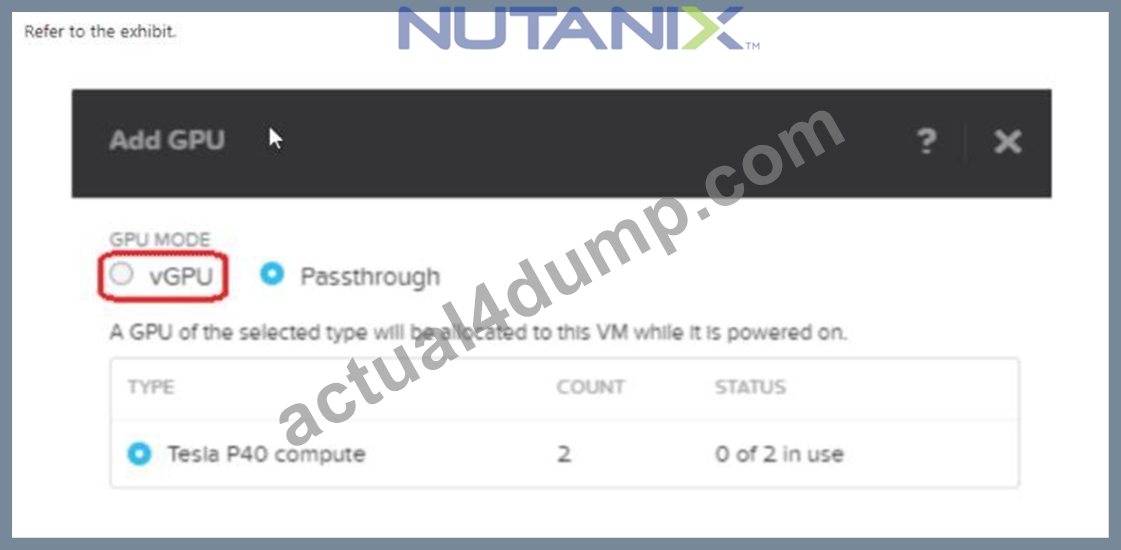
An administrator is configuring a virtual desktop gold master image with P40 NVIDIA vGPU. upon trying to add a vCPU assignment in Prism Element, the administrator noticed that it is not selectable and cannot proceed.
Which two actions are correct steps to resolve this issue? (Choose two.)
- A. Install the NVIDIA GPU drivers on the Gold Master.
- B. Check if ECC Mode is turned on by running nvdia-smi -q | grep "ECC Mode" -A2
- C. Disable ECC by running nvdia-smi -e 0.
- D. Install the NVIDIA GPU Manager Driver.
Answer: B,C
Explanation:
ECC (Error Correcting Code) mode is a feature of some NVIDIA GPUs that provides error detection and correction for memory errors. However, ECC mode can interfere with vGPU functionality and prevent vGPU- enabled VMs from being created or started1. Therefore, two correct steps to resolve this issue are B (Disable ECC by running nvdia-smi -e 0) and D (Check if ECC Mode is turned on by running nvdia-smi -q | grep
"ECC Mode" -A2).
https://portal.nutanix.com/page/documents/kbs/details?targetId=kA00e000000LKjOCAW
NEW QUESTION # 99
An administrator is tasked with optimizing storage for persistent VDI desktops.
How should the administrator configure the storage containers?
- A. Compression: Enabled | Deduplication: Enabled | Erasure Coding: Disabled
- B. Compression: Enabled | Deduplication: Disabled | Erasure Coding: Disabled
- C. Compression: Enabled | Deduplication: Disabled | Erasure Coding: Enabled
- D. Compression: Enabled | Deduplication: Enabled | Erasure Coding: Enabled
Answer: A
Explanation:
Comprehensive and Detailed Explanation From Exact Extract of Nutanix End User Computing documents:
According to Nutanix Storage Best Practices for Citrix/VDI:
* Workload Type: The question specifies Persistent VDI, which typically uses Full Clones.
* Deduplication: For Full Clones/Persistent Desktops, the data (OS and Apps) is identical across many VMs but stored independently. Deduplication (specifically Capacity Tier Deduplication) is Enabled to eliminate these redundant blocks and save significant capacity.
* Compression: Inline Compression is Enabled by default and recommended for all VDI workloads to improve performance and capacity usage.
* Erasure Coding (EC-X): Nutanix documentation explicitly states that Erasure Coding is Disabled for active VDI workloads. EC-X provides capacity savings for "write-cold" data (like backups or archives) but introduces a performance penalty (parity calculation overhead) on random writes, which are common in persistent desktop usage.
* Correction: While option D suggests enabling everything, the specific best practice table for "Citrix MCS: Full Clone" lists Erasure Coding as Disabled to maintain optimal user experience.
NEW QUESTION # 100
An administrator is trying to add a Nutanix cluster as a new connection, but connection name Nutanix AHV is not listed in the Connection type menu.
What should the administrator do to resolve this issue?
- A. Install the Nutanix AHV plugin for Citrix Director on Delivery controllers.
- B. Install the Nutanix AHV plugin for Citrix Director on Storefront Servers.
- C. Install the Nutanix AHV plugin for Citrix on all Storefront.
- D. Install the Nutanix AHV plugin for Citrix controllers.
Answer: D
Explanation:
This is because this option will enable the administrator to add a Nutanix cluster as a new connection by installing and registering the plugin on the Delivery Controllers that manage the connection type menu.
https://portal.nutanix.com/page/documents/solutions/details?targetId=BP-2079-Citrix-Virtual-Apps-and-Desktops:BP-2079-Citrix-Virtual-Apps-and-Desktops
NEW QUESTION # 101
An administrator is setting up a storage container to provision Citrix MCS Non-persistent desktops. This storage container is dedicated to these desktops.
Which settings should the administrator select to optimize the storage?
- A. Compression Enabled, Deduplication Enabled, Erasure Coding Disabled
- B. Compression Enabled, Deduplication Disabled, Erasure Coding Disabled
- C. Compression Enabled, Deduplication Enabled, Erasure Coding Disabled
- D. Compression Disabled, Deduplication Enabled, Erasure Coding Disabled
Answer: B
Explanation:
According to the "Citrix Virtual Apps and Desktops on Nutanix" best practices guide, the recommended storage container configuration depends on the provisioning method. For Citrix MCS (Machine Creation Services) Non-persistent workloads, the following settings are explicitly recommended in the Nutanix storage table:
* Compression: Enabled (Inline compression is recommended for all workloads to improve capacity and performance).
* Deduplication: Disabled (For non-persistent MCS, the write-heavy differencing disks are deleted upon reboot, making post-process capacity deduplication ineffective. While performance deduplication can help with reads, Nutanix Shadow Clones automatically handle caching of the base image on AHV, rendering deduplication largely redundant and an unnecessary overhead for this specific use case).
* Erasure Coding: Disabled (Erasure coding is not suitable for the random write patterns and "hot" data associated with active VDI desktops; it is designed for cold, archive data).
Therefore, the correct configuration is Compression Enabled, Deduplication Disabled, and Erasure Coding Disabled.
Here are the 100% verified answers and detailed explanations based on the latest Nutanix End User Computing and Best Practices documentation.
NEW QUESTION # 102
A company is deploying a Nutanix VDI solution across multiple data centers and will be using Files for their profile\home directories. The company requires that users be able to access profile\home from a local Files cluster at the designated data center they will be logging into, based on the location they are working out of that day.
How can the administrator ensure that the solution meets the stated requirements?
- A. use Nutanix Advanced File Replication
- B. use PeerSync software to replicate.
- C. use Zetro software to replicate
- D. use Nutanix Protection Domains for replication.
Answer: A
Explanation:
Nutanix Files offers a feature called Smart DR, which enables share-level replication between active file server instances for disaster recovery.
Smart DR allows administrators to configure replication policies for each share, such as replication interval, retention period, and bandwidth limit.
Smart DR also supports failover and failback operations between source and target file servers in case of a disaster.
According to Nutanix best practices1, Smart DR is suitable for scenarios where users need to access their files from different locations or data centers.
https://next.nutanix.com/community-blog-154/nutanix-files-3-8-and-file-analytics-3-0-39309
NEW QUESTION # 103
Recently, the vice president Of IT infrastructure was migrated from a physical computer to a virtual desktop.
The administrator wants to ensure that this user has the best possible experience and wants to be notified if any CPU resource constraints.
The cluster's average CPU utilization is 20%.
What step would help the administrator to know when there are resource problems on the virtual desktop?
- A. Create a new alert policy to alert if the CPU on the virtual desktop's cluster is over 90%.
- B. Create a new alert policy to alert if the CPU on the virtual desktop is over and configure a Playbook to Slack the information to the administrator,
- C. Create a new alert policy to alert if the CPU on the virtual desktop is over and configure a Playbook to power off the virtual desktop.
- D. Create a new alert policy to alert if the CPU on the virtual desktop's host is over 90%.
Answer: B
Explanation:
alert policies are rules that define the conditions for generating alerts on Nutanix clusters1. You can create custom alert policies based on your specific needs and preferences2Playbooks are automated workflows that perform actions based on triggers such as alerts3. You can create playbooks using predefined alerts or alerts matching criteria3.
To ensure that the vice president of IT infrastructure has the best possible experience and to be notified if any CPU resource constraints on the virtual desktop, one possible solution is to create a new alert policy to alert if the CPU on the virtual desktop is over a certain threshold (for example, 80%) and configure a playbook to send a notification (forexample, via email or Slack) to the administrator23. This way, the administrator can monitor the performance of the virtual desktop and take appropriate actions if needed.
https://portal.nutanix.com/page/documents/details?targetId=Prism-Central-Guide-vpc_2022_6:mul-alert-policies
NEW QUESTION # 104
......
Use Valid New NCP-EUC Test Notes & NCP-EUC Valid Exam Guide: https://www.actual4dump.com/Nutanix/NCP-EUC-actualtests-dumps.html
NCP-EUC Actual Questions Answers PDF 100% Cover Real Exam Questions: https://drive.google.com/open?id=1G-P_7nAzDEpHaLQ2e8Pm01iByE15iZd6