

Download Juniper JN0-214 Exam Dumps to Pass Exam Easily in 2025
Get 100% Real Free JNCIA-Cloud JN0-214 Sample Questions
NEW QUESTION # 11
You want to limit the memory, CPU, and network utilization of a set of processes running on a Linux host.
Which Linux feature would you configure in this scenario?
You want to limit the memory, CPU, and network utilization of a set of processes running on a Linux host.
Which Linux feature would you configure in this scenario?
- A. network namespaces
- B. virtual routing and forwarding instances
- C. slicing
- D. control groups
Answer: D
Explanation:
Linux provides several features to manage system resources and isolate processes. Let's analyze each option:
A . virtual routing and forwarding instances
Incorrect: Virtual Routing and Forwarding (VRF) is a networking feature used to create multiple routing tables on a single router or host. It is unrelated to limiting memory, CPU, or network utilization for processes.
B . network namespaces
Incorrect: Network namespaces are used to isolate network resources (e.g., interfaces, routing tables) for processes. While they can help with network isolation, they do not directly limit memory or CPU usage.
C . control groups
Correct: Control Groups (cgroups) are a Linux kernel feature that allows you to limit, account for, and isolate the resource usage (CPU, memory, disk I/O, network) of a set of processes. cgroups are commonly used in containerization technologies like Docker and Kubernetes to enforce resource limits.
D . slicing
Incorrect: "Slicing" is not a recognized Linux feature for resource management. This term may refer to dividing resources in other contexts but is not relevant here.
Why Control Groups?
Resource Management: cgroups provide fine-grained control over memory, CPU, and network utilization, ensuring that processes do not exceed their allocated resources.
Containerization Foundation: cgroups are a core technology behind container runtimes like containerd and orchestration platforms like Kubernetes.
JNCIA Cloud Reference:
The JNCIA-Cloud certification covers Linux features like cgroups as part of its containerization curriculum. Understanding cgroups is essential for managing resource allocation in cloud environments.
For example, Juniper Contrail integrates with Kubernetes to manage containerized workloads, leveraging cgroups to enforce resource limits.
Reference:
Linux Kernel Documentation: Control Groups
Juniper JNCIA-Cloud Study Guide: Linux Features
NEW QUESTION # 12
Which two statements are true regarding isolated namespaces in Juniper Cloud-Native Contrail Networking (CN2)? (Choose two.)
- A. Pods in isolated namespaces can reach services in non-isolated namespaces.
- B. Pods in isolated namespaces can only reach services in the same namespace.
- C. Pods in isolated namespaces can only communicate with pods in the same namespace.
- D. Pods in isolated namespaces can communicate with pods in non-isolated namespaces.
Answer: B,C
Explanation:
In Juniper Cloud-Native Contrail Networking (CN2), isolated namespaces are used to isolate a pod from other pods without explicitly configuring a network policy. Pods in an isolated namespace can only communicate with pods in the same namespace. They cannot reach pods or services in other isolated or non-isolated namespaces.
NEW QUESTION # 13
Which two statements about containers are true? (Choose two.)
- A. Containers share the use of the underlying system's kernel.
- B. Containers package the entire runtime environment of an application, including its dependencies.
- C. Containers can only run on a system with a Type 2 hypervisor.
- D. Containers contain executables, libraries, configuration files, and an operating system.
Answer: A,B
Explanation:
Containers are a lightweight form of virtualization that enable the deployment of applications in isolated environments. Let's analyze each statement:
A . Containers contain executables, libraries, configuration files, and an operating system.
Incorrect: Containers do not include a full operating system. Instead, they share the host system's kernel and only include the application and its dependencies (e.g., libraries, binaries, and configuration files).
B . Containers package the entire runtime environment of an application, including its dependencies.
Correct: Containers bundle the application code, runtime, libraries, and configuration files into a single package. This ensures consistency across different environments and eliminates issues caused by differences in dependencies.
C . Containers can only run on a system with a Type 2 hypervisor.
Incorrect: Containers do not require a hypervisor. They run directly on the host operating system and share the kernel. Hypervisors (Type 1 or Type 2) are used for virtual machines, not containers.
D . Containers share the use of the underlying system's kernel.
Correct: Containers leverage the host operating system's kernel, which allows them to be lightweight and efficient. Each container has its own isolated user space but shares the kernel with other containers.
Why These Statements?
Runtime Environment Packaging: Containers ensure portability and consistency by packaging everything an application needs to run.
Kernel Sharing: By sharing the host kernel, containers consume fewer resources compared to virtual machines, which require separate operating systems.
JNCIA Cloud Reference:
The JNCIA-Cloud certification emphasizes understanding containerization technologies, including Docker and Kubernetes. Containers are a fundamental component of modern cloud-native architectures.
For example, Juniper Contrail integrates with Kubernetes to manage containerized workloads, leveraging the lightweight and portable nature of containers.
Reference:
Docker Documentation: Container Basics
Juniper JNCIA-Cloud Study Guide: Containerization
NEW QUESTION # 14
Which two Linux commands would you use to show the amount of RAM in your system? (Choose two.)
- A. cat /proc/meminto
- B. free -h
- C. df -h
- D. cat /proc/cpuinfo
Answer: A,B
Explanation:
he free -h command in Linux displays the total amount of free and used physical and swap memory in the system, as well as the buffers used by the kernel. The cat /proc/meminfo command displays real-time information about the system's memory usage as well as the buffers and shared memory used by the kernel.
NEW QUESTION # 15
What are two characteristics of the OpenShift Assisted Installer? (Choose two.)
- A. It provides full feature support and customizations.
- B. It uses one of the control plane nodes as a bootstrap node.
- C. It offers REST APIs for the configuration and installation
- D. It does not support bare-metal deployments.
Answer: B,C
Explanation:
The OpenShift Assisted Installer uses one of the control plane nodes as a bootstrap node. It also offers REST APIs for the configuration and installation.
NEW QUESTION # 16
You want to quickly assign a specific combination of permissions to a set of users.
In this scenario, which OpenStack object should you create?
- A. role
- B. project
- C. image
- D. flavor
Answer: A
Explanation:
In OpenStack, a role is a set of permissions that determines what actions users can perform in a given context. Roles are assigned to user-project pairs. If you want to quickly assign a specific combination of permissions to a set of users, you should create a role.
NEW QUESTION # 17
Which SDN model provisions tunnels between the virtual endpoints within and across data centers?
- A. SDN overlay
- B. SDN by APIs
- C. switch-based SDN
- D. open SDN
Answer: A
Explanation:
The SDN overlay model provisions tunnels between the virtual endpoints within and across data centers. This model uses network overlays to support private communication between instances.
NEW QUESTION # 18
Which component of a software-defined networking (SDN) controller defines where data packets are forwarded by a network device?
- A. the control plane
- B. the forwarding plane
- C. the operational plane
- D. the management plane
Answer: B
Explanation:
The forwarding plane (also known as the data plane) of a software-defined networking (SDN) controller is responsible for forwarding data packets based on the instructions given by the control plane. It handles all activities involving data packets sent by the end-user, including forwarding of packets.
NEW QUESTION # 19
Click the Exhibit button.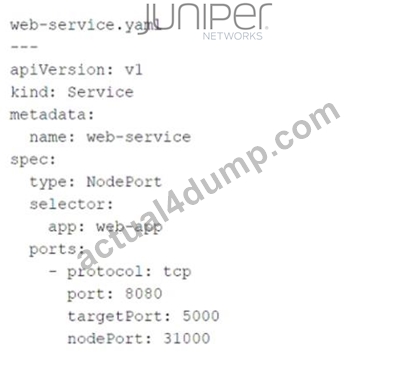
Referring to the exhibit, which port number would external users use to access the WEB application?
- A. 0
- B. 1
- C. 2
- D. 3
Answer: B
Explanation:
The YAML file provided in the exhibit defines a Kubernetes Service object of type NodePort. Let's break down the key components of the configuration and analyze how external users access the WEB application:
Key Fields in the YAML File:
type: NodePort:
This specifies that the service is exposed on a static port on each node in the cluster. External users can access the service using the node's IP address and the assigned nodePort.
port: 8080:
This is the port on which the service is exposed internally within the Kubernetes cluster. Other services or pods within the cluster can communicate with this service using port 8080.
targetPort: 5000:
This is the port on which the actual application (WEB application) is running inside the pod. The service forwards traffic from port: 8080 to targetPort: 5000.
nodePort: 31000:
This is the port on the node (host machine) where the service is exposed externally. External users will use this port to access the WEB application.
How External Users Access the WEB Application:
External users access the WEB application using the node's IP address and the nodePort value (31000).
The Kubernetes service listens on this port and forwards incoming traffic to the appropriate pods running the WEB application.
Why Not Other Options?
A . 80: Port 80 is commonly used for HTTP traffic, but it is not specified in the YAML file. The service does not expose port 80 externally.
B . 8080: Port 8080 is the internal port used within the Kubernetes cluster. It is not the port exposed to external users.
D . 5000: Port 5000 is the target port where the application runs inside the pod. It is not directly accessible to external users.
Why 31000?
NodePort Service Type: The NodePort service type exposes the application on a high-numbered port (default range: 30000-32767) on each node in the cluster.
External Accessibility: External users must use the nodePort value (31000) along with the node's IP address to access the WEB application.
JNCIA Cloud Reference:
The JNCIA-Cloud certification covers Kubernetes networking concepts, including service types like ClusterIP, NodePort, and LoadBalancer. Understanding how NodePort services work is essential for exposing applications to external users in Kubernetes environments.
For example, Juniper Contrail integrates with Kubernetes to provide advanced networking features, such as load balancing and network segmentation, for services like the one described in the exhibit.
Reference:
Kubernetes Documentation: Service Types
Juniper JNCIA-Cloud Study Guide: Kubernetes Networking
NEW QUESTION # 20
Click to the Exhibit button.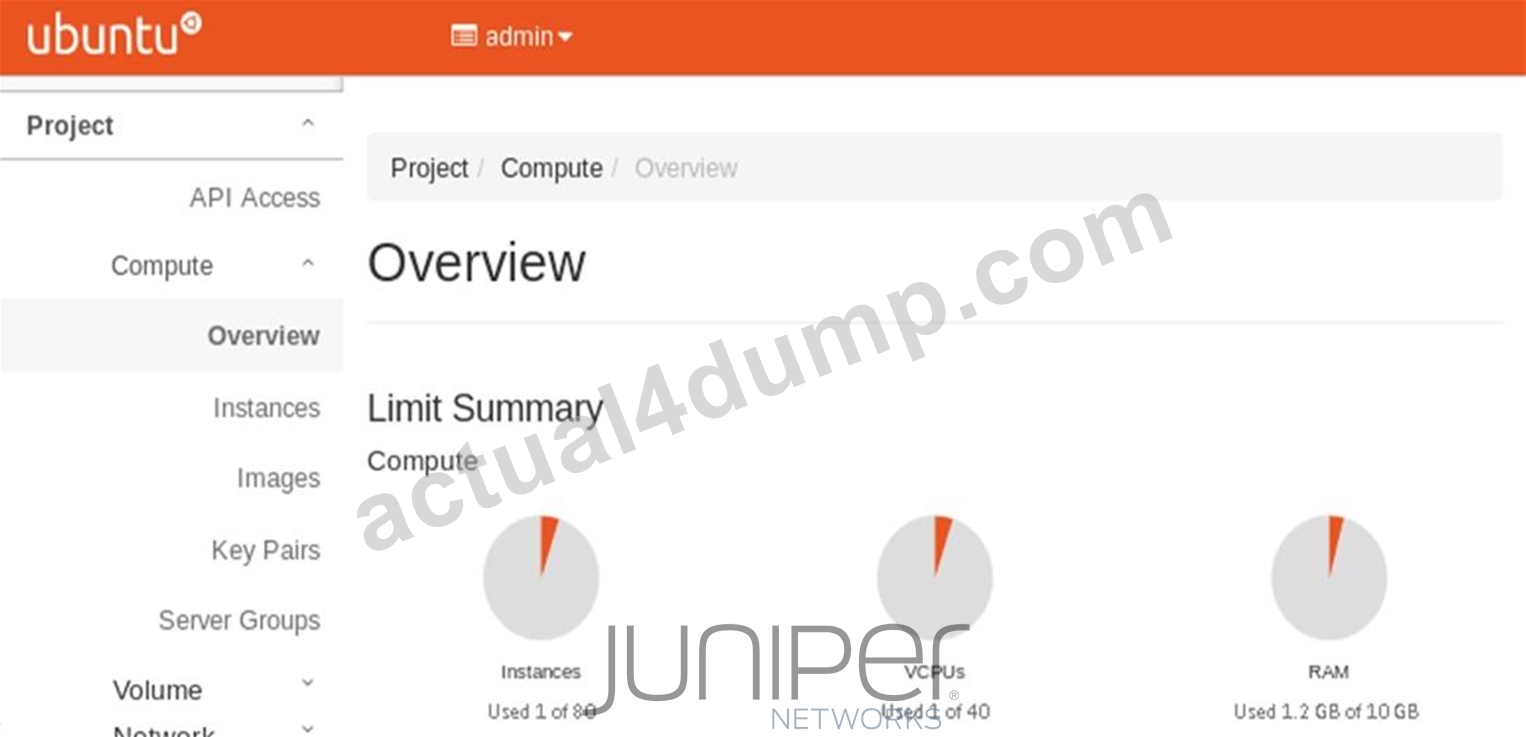
Referring to the exhibit, which OpenStack service provides the UI shown in the exhibit?
- A. Neutron
- B. Nova
- C. Heat
- D. Horizon
Answer: D
Explanation:
The UI shown in the exhibit is the OpenStack Horizon dashboard. Horizon is the web-based user interface (UI) for OpenStack, providing administrators and users with a graphical interface to interact with the cloud environment. Through Horizon, users can manage resources like instances, networks, and storage, which is evident in the displayed metrics (Instances, VCPUs, RAM) for the project.
NEW QUESTION # 21
Which component is directly responsible for running containers in a Kubernetes node?
- A. container runtime
- B. kube-proxy
- C. kube controller
- D. kubelet
Answer: A
Explanation:
This question seems to be asking about a Kubernetes component that is responsible for running containers. Let's analyze each option:
A . kubelet
Incorrect: The kubelet is responsible for managing the state of pods and containers on a worker node. It ensures that containers are running as expected but does not directly execute or run the containers.
B . kube-proxy
Incorrect: The kube-proxy manages network communication for services and pods by implementing load balancing and routing rules. It does not handle the execution of containers.
C . container runtime
Correct: The container runtime (e.g., containerd, cri-o) is the component that actually runs and manages containers on a Kubernetes node. It interacts with the operating system to start, stop, and manage containerized applications.
D . kube controller
Incorrect: The kube controller is part of the control plane and ensures that the desired state of the cluster (e.g., number of replicas) is maintained. It does not directly run containers.
Why Container Runtime?
Execution of Containers: The container runtime is responsible for pulling container images, starting containers, and managing their lifecycle.
Integration with Kubernetes: Kubernetes communicates with the container runtime through the Container Runtime Interface (CRI).
JNCIA Cloud Reference:
The JNCIA-Cloud certification covers Kubernetes architecture, including the role of the container runtime. Understanding how containers are executed is essential for managing Kubernetes clusters.
For example, Juniper Contrail integrates with Kubernetes to provide networking and security for containerized workloads, relying on the container runtime to execute applications.
Reference:
Kubernetes Documentation: Container Runtimes
Juniper JNCIA-Cloud Study Guide: Kubernetes Architecture
NEW QUESTION # 22
Click the Exhibit button.
Referring to the exhibit, which two statements are correct? (Choose two.)
- A. The myvSRX instance is using a default image.
- B. The c using a custom flavor.
- C. The myvSRX instance is part of a default network.
- D. The myvSRX instance is currently running.
Answer: B,D
Explanation:
Based on the image description provided, the instance named 'myvSRX' appears to be using a custom flavor (not default) and is currently in an 'ACTIVE' state, which means it is running.
NEW QUESTION # 23
What are the two characteristics of the Network Functions Virtualization (NFV) framework?
(Choose two.)
- A. It decouples the network control plane from the forwarding plane.
- B. It implements virtualized network functions
- C. It implements virtualized tunnel endpoints.
- D. It decouples the network software from the hardware.
Answer: B,D
Explanation:
The two characteristics of the Network Functions Virtualization (NFV) framework are that it implements virtualized network functions (VNFs) and that it decouples the network software from the hardware. According to the NFV overview by VMware, NFV is "designed to deliver the network services needed to support an infrastructure totally independent from hardware by decoupling network functions from proprietary purpose-built hardware appliances" and that "the software that provides these network services are known as virtual network functions (VNFs) and run on generic hardware". Other characteristics that are mentioned in the question are related to Software Defined Networking (SDN), not NFV. SDN separates the network control plane from the forwarding plane and implements virtualized tunnel endpoints.
NEW QUESTION # 24
Which two functions does CN2 provide? (Choose two.)
- A. It provides underlay network management capabilities.
- B. It performs SDN functions in an NFV solution.
- C. It provides an orchestration solution for VMs and containers.
- D. It provides enhanced networking capabilities to private clouds.
Answer: C,D
Explanation:
CN2 (Cranial Nerve II), also known as the optic nerve, controls the special sense of vision. It transmits visual information from the retina to the vision centers of the brain. Two functions that CN2 provides are:
It provides enhanced networking capabilities to private clouds. It transmits special afferent impulses of light to the brain and is involved in several reflex arcs related to the ocular system.
It provides an orchestration solution for VMs and containers. It is a unique structure that functions as the bridge between the retinal layer of the eyes and the visual cortex of the brain.
NEW QUESTION # 25
Which virtualization method requires less duplication of hardware resources?
- A. OS-level virtualization
- B. full virtualization
- C. hardware-assisted virtualization
- D. paravirtualization
Answer: A
Explanation:
Virtualization methods differ in how they utilize hardware resources. Let's analyze each option:
A . OS-level virtualization
Correct: OS-level virtualization (e.g., containers) uses the host operating system's kernel to run isolated user-space instances (containers). Since containers share the host OS kernel, there is less duplication of hardware resources compared to other virtualization methods.
B . hardware-assisted virtualization
Incorrect: Hardware-assisted virtualization (e.g., Intel VT-x, AMD-V) enables full virtual machines (VMs) to run on physical hardware. Each VM includes its own operating system, leading to duplication of resources like memory and CPU.
C . full virtualization
Incorrect: Full virtualization involves running a complete guest operating system on top of a hypervisor. Each VM requires its own OS, resulting in significant resource duplication.
D . paravirtualization
Incorrect: Paravirtualization modifies the guest operating system to communicate directly with the hypervisor. While it reduces some overhead compared to full virtualization, it still requires separate operating systems for each VM, leading to resource duplication.
Why OS-Level Virtualization?
Resource Efficiency: Containers share the host OS kernel, eliminating the need for multiple operating systems and reducing resource duplication.
Lightweight: Containers are faster to start and consume fewer resources compared to VMs.
JNCIA Cloud Reference:
The JNCIA-Cloud certification emphasizes understanding virtualization technologies, including OS-level virtualization. Containers are a key component of modern cloud-native architectures due to their efficiency and scalability.
For example, Juniper Contrail integrates with container orchestration platforms like Kubernetes to manage OS-level virtualization workloads efficiently.
Reference:
Docker Documentation: Container Basics
Juniper JNCIA-Cloud Study Guide: Virtualization
NEW QUESTION # 26
Which term identifies to which network a virtual machine interface is connected?
- A. virtual network ID (VNID)
- B. machine access control (MAC)
- C. Virtual Extensible LAN (VXLAN)
- D. virtual tunnel endpoint (VTEP)
Answer: A
Explanation:
The term that identifies to which network a virtual machine interface is connected is the virtual network ID (VNID). The VNID is a unique identifier assigned to each virtual network. It is used to differentiate between different virtual networks and to ensure that each virtual machine interface is connected to the correct network.
NEW QUESTION # 27
You are provisioning workloads on worker nodes in a Kubernetes cluster.
Which CN2 component is responsible for generating associated routes?
- A. vRouter forwarding plane
- B. vRouter agent microservice
- C. Configuration Resource (CR) controllers
- D. Contrail kube-manager
Answer: B
Explanation:
The vRouter agent microservice is the CN2 component responsible for generating associated routes. When a pod is scheduled on a node, the vRouter agent on that node programs the necessary routes in the kernel routing table to ensure that traffic destined for that pod is properly routed.
NEW QUESTION # 28
Which two statements about Kubernetes are correct? (Choose two.)
- A. All containers within a pod share the same IP address.
- B. Each container within a pod has a unique IP address.
- C. A ClusterlP service exposes pods to internal and external traffic.
- D. A ClusterlP service exposes pods to internal traffic only.
Answer: A,D
Explanation:
In Kubernetes, all containers within a pod share the same IP address. A ClusterIP service exposes pods to internal traffic only.
NEW QUESTION # 29
Which Linux protection ring is the least privileged?
- A. 0
- B. 1
- C. 2
- D. 3
Answer: A
Explanation:
In Linux systems, the concept of protection rings is used to define levels of privilege for executing processes and accessing system resources. These rings are part of the CPU's architecture and provide a mechanism for enforcing security boundaries between different parts of the operating system and user applications. There are typically four rings in the x86 architecture, numbered from 0 to 3:
Ring 0 (Most Privileged): This is the highest level of privilege, reserved for the kernel and critical system functions. The operating system kernel operates in this ring because it needs unrestricted access to hardware resources and control over the entire system.
Ring 1 and Ring 2: These intermediate rings are rarely used in modern operating systems. They can be utilized for device drivers or other specialized purposes, but most operating systems, including Linux, do not use these rings extensively.
Ring 3 (Least Privileged): This is the least privileged ring, where user-level applications run. Applications running in Ring 3 have limited access to system resources and must request services from the kernel (which runs in Ring 0) via system calls. This ensures that untrusted or malicious code cannot directly interfere with the core system operations.
Why Ring 3 is the Least Privileged:
Isolation: User applications are isolated from the core system functions to prevent accidental or intentional damage to the system.
Security: By restricting access to hardware and sensitive system resources, the risk of vulnerabilities or exploits is minimized.
Stability: Running applications in Ring 3 ensures that even if an application crashes or behaves unexpectedly, it does not destabilize the entire system.
JNCIA Cloud Reference:
The Juniper Networks Certified Associate - Cloud (JNCIA-Cloud) curriculum emphasizes understanding virtualization, cloud architectures, and the underlying technologies that support them. While the JNCIA-Cloud certification focuses more on Juniper-specific technologies like Contrail, it also covers foundational concepts such as virtualization, Linux, and cloud infrastructure.
In the context of virtualization and cloud environments, understanding the role of protection rings is important because:
Hypervisors often run in Ring 0 to manage virtual machines (VMs).
VMs themselves run in a less privileged ring (e.g., Ring 3) to ensure isolation between the guest operating systems and the host system.
For example, in a virtualized environment like Juniper Contrail, the hypervisor (e.g., KVM) manages the execution of VMs. The hypervisor operates in Ring 0, while the guest OS and applications within the VM operate in Ring 3. This separation ensures that the VMs are securely isolated from each other and from the host system.
Thus, the least privileged Linux protection ring is Ring 3 , where user applications execute with restricted access to system resources.
Reference:
Juniper JNCIA-Cloud Study Guide: Virtualization Basics
x86 Architecture Protection Rings Documentation
NEW QUESTION # 30
You are asked to deploy a cloud solution for a customer that requires strict control over their resources and data. The deployment must allow the customer to implement and manage precise security controls to protect their data.
Which cloud deployment model should be used in this situation?
- A. public cloud
- B. hybrid cloud
- C. dynamic cloud
- D. private cloud
Answer: D
Explanation:
Cloud deployment models define how cloud resources are provisioned and managed. The four main models are:
Public Cloud: Resources are shared among multiple organizations and managed by a third-party provider. Examples include AWS, Microsoft Azure, and Google Cloud Platform.
Private Cloud: Resources are dedicated to a single organization and can be hosted on-premises or by a third-party provider. Private clouds offer greater control over security, compliance, and resource allocation.
Hybrid Cloud: Combines public and private clouds, allowing data and applications to move between them. This model provides flexibility and optimization of resources.
Dynamic Cloud: Not a standard cloud deployment model. It may refer to the dynamic scaling capabilities of cloud environments but is not a recognized category.
In this scenario, the customer requires strict control over their resources and data, as well as the ability to implement and manage precise security controls. A private cloud is the most suitable deployment model because:
Dedicated Resources: The infrastructure is exclusively used by the organization, ensuring isolation and control.
Customizable Security: The organization can implement its own security policies, encryption mechanisms, and compliance standards.
On-Premises Option: If hosted internally, the organization retains full physical control over the data center and hardware.
Why Not Other Options?
Public Cloud: Shared infrastructure means less control over security and compliance. While public clouds offer robust security features, they may not meet the strict requirements of the customer.
Hybrid Cloud: While hybrid clouds combine the benefits of public and private clouds, they introduce complexity and may not provide the level of control the customer desires.
Dynamic Cloud: Not a valid deployment model.
JNCIA Cloud Reference:
The JNCIA-Cloud certification covers cloud deployment models and their use cases. Private clouds are highlighted as ideal for organizations with stringent security and compliance requirements, such as financial institutions, healthcare providers, and government agencies.
For example, Juniper Contrail supports private cloud deployments by providing advanced networking and security features, enabling organizations to build and manage secure, isolated cloud environments.
Reference:
Juniper JNCIA-Cloud Study Guide: Cloud Deployment Models
NIST Cloud Computing Reference Architecture
NEW QUESTION # 31
You just uploaded a qcow2 image of a vSRX virtual machine in OpenStack.
In this scenario, which service stores the virtual machine (VM) image?
- A. Neutron
- B. Nova
- C. Glance
- D. Ironic
Answer: C
Explanation:
The service that stores the virtual machine (VM) image in OpenStack is Glance. Glance is the image service in OpenStack that allows you to discover, register, retrieve, and store virtual machine images.
NEW QUESTION # 32
Which component of Kubernetes runs on all nodes and ensures that the containers are running in a pod?
- A. container runtime
- B. kubelel
- C. kube-proxy
- D. kube controller
Answer: B
Explanation:
The kubelet is a component of Kubernetes that runs on all nodes in the cluster and ensures that containers are running in a pod. It takes a set of PodSpecs that are provided through various mechanisms and ensures that the containers described in those PodSpecs are running and healthy.
NEW QUESTION # 33
You are asked to run a container in a Kubernetes environment.
What should you do to accomplish this task?
- A. Create a JINJA2 template for the container and its resources.
- B. Define an XML configuration for the container and its resources.
- C. Create a WYSYG definition for the container and its resources.
- D. Define a YAML manifest for the container and its resources.
Answer: D
Explanation:
To run a container in a Kubernetes environment, you should define a YAML manifest for the container and its resources. YAML manifests are used to define Kubernetes objects, such as pods or services. These manifests describe the desired state of the system.
NEW QUESTION # 34
Which two statements are correct about an underlay network? (Choose two.)
- A. The underlay network is built using encapsulations tunnels.
- B. The underlay network is the virtual network used to connect multiple virtual machines (VMs).
- C. An underlay network can be built using either Layer 2 or Layer 3 connectivity.
- D. A Layer 3 underlay network uses routing protocols to provide IP connectivity.
Answer: C,D
Explanation:
An underlay network refers to the physical or logical network infrastructure that provides the foundation for overlay networks in cloud environments. It handles the actual transport of data between devices and serves as the backbone for cloud architectures. Let's analyze each statement:
A . An underlay network can be built using either Layer 2 or Layer 3 connectivity.
Correct: Underlay networks can operate at both Layer 2 (switching) and Layer 3 (routing). For example:
Layer 2: Uses Ethernet switching to forward traffic within a single broadcast domain.
Layer 3: Uses IP routing to forward traffic across multiple subnets or networks.
B . A Layer 3 underlay network uses routing protocols to provide IP connectivity.
Correct: In a Layer 3 underlay network, routing protocols like OSPF, BGP, or EIGRP are used to exchange routing information and ensure IP connectivity between devices. This is common in large-scale cloud environments where scalability and segmentation are critical.
C . The underlay network is the virtual network used to connect multiple virtual machines (VMs).
Incorrect: The underlay network is the physical or logical infrastructure that supports the overlay network. The overlay network, on the other hand, is the virtual network used to connect VMs, containers, or other endpoints. The underlay provides the foundation, while the overlay adds abstraction and flexibility.
D . The underlay network is built using encapsulations tunnels.
Incorrect: Encapsulation tunnels (e.g., VXLAN, GRE) are used in overlay networks, not underlay networks. The underlay network provides the physical or logical transport layer, while the overlay network uses tunnels to create virtualized network segments.
Why These Answers?
Layer 2 and Layer 3 Flexibility: The underlay network must support both switching and routing to accommodate diverse workloads and topologies.
Routing Protocols in Layer 3: Routing protocols are essential for scalable and efficient IP connectivity in Layer 3 underlay networks.
JNCIA Cloud Reference:
The JNCIA-Cloud certification covers underlay and overlay networks as part of its discussion on cloud architectures. Understanding the distinction between underlay and overlay networks is crucial for designing and managing cloud environments.
For example, Juniper Contrail uses an underlay network to provide the physical connectivity required for overlay networks. The underlay ensures reliable and scalable transport, while the overlay enables flexible virtualized networking.
Reference:
Juniper JNCIA-Cloud Study Guide: Underlay and Overlay Networks
Network Virtualization Documentation
NEW QUESTION # 35
......
Juniper JN0-214 Exam Syllabus Topics:
| Topic | Details |
|---|---|
| Topic 1 |
|
| Topic 2 |
|
| Topic 3 |
|
| Topic 4 |
|
| Topic 5 |
|
JN0-214 Study Guide Realistic Verified Dumps: https://www.actual4dump.com/Juniper/JN0-214-actualtests-dumps.html
Accurate JN0-214 Questions with Free and Fast Updates: https://drive.google.com/open?id=1WwyVh3dOR7i0MouKkqRDht2OKw8iZUhw