

Get Special Discount Offer of CCRN-Adult Certification Exam Sample Questions and Answers
New CCRN-Adult Dumps For Preparing AACN CCRN Certified AACN Exam Well
NEW QUESTION # 247
The critical care nurse is providing teaching to a patient who experienced a Transient Ischemic Attack (TIA). Which of the following statements made by the patient indicates that they understand the teaching?
- A. A TIA occurs when there is bleeding in the brain, but not enough to do any significant damage.
- B. The effects of this TIA will be permanent, but less severe than if I had a full stroke.
- C. That was a close call. I need to get treatment before I have a big stroke.
- D. Once the TIA is over, I am fine and there is nothing more to worry about.
Answer: C
Explanation:
A Transient Ischemic Attack (TIA) is a period of ischemia that resolves spontaneously prior to causing lasting tissue necrosis. While a TIA does not create any lasting effects, it is an important warning sign that an ischemic stroke may be impending. TIAs are caused by ischemia, not bleeding.
NEW QUESTION # 248
Which of the following tests BEST evaluates for an occluded chest tube?
- A. Physical examination
- B. Ultrasound
- C. Computed tomography (CT)
- D. Chest x-ray
Answer: C
Explanation:
CTs and magnetic resonance imaging (MRI) allow for the three-dimensional examination of the chest in situations where two-dimensional chest x-rays are insufficient. Malpositioned or occluded chest tubes are problems for which a three-dimensional view provided by CT and MRI is more sensitive than a chest x-ray.
Ultrasound is not used to assess for occlusions of chest tubes.
Physical examination may identify occlusions that are present externally; however, more advanced techniques are needed to evaluate for internal chest tube occlusions.
NEW QUESTION # 249
The need for informed consent is guided by which of the following ethical principles?
- A. Fidelity
- B. Autonomy
- C. Nonmaleficence
- D. Justice
Answer: B
Explanation:
The intent of the informed consent process is based on the principle of autonomy. The consent process provides an individual with the necessary information to compare options and make a reasoned choice.
Patients should be thoroughly educated and informed prior to providing consent.
NEW QUESTION # 250
Assessment of a patient with a head injury reveals increased muscle tone and contractured positioning of the upper extremities. A nurse should
- A. consult a physical therapist regarding appropriate positioning.
- B. recognize that contractures are an expected response after a head injury.
- C. use wrist restraints to maintain upper extremity extension.
- D. obtain an order for a muscle relaxer.
Answer: A
Explanation:
In patients with head injuries, increased muscle tone and contractured positioning (such as decorticate or decerebrate posturing) are signs of significant neurological impairment. It is essential to manage these symptoms to prevent further complications. Consulting a physical therapist is the best course of action to ensure appropriate positioning, prevent contractures, and manage spasticity effectively. References: = CCRN Exam Handbook and AACN's Certification Review Course materials.
NEW QUESTION # 251
Which of the following is MOST LIKELY to be the cause of hypertrophic cardiomyopathy?
- A. Aortic stenosis
- B. Alcohol use
- C. Myocardial fibrosis
- D. Chagas disease
Answer: A
Explanation:
Hypertrophic cardiomyopathy is most likely to be caused by aortic stenosis, causing increased afterload and hypertrophy of the ventricular myocardium. Chagas disease and alcohol use are most likely to cause dilated cardiomyopathy, while myocardial fibrosis is most likely to cause restrictive cardiomyopathy.
NEW QUESTION # 252
A patient lying on the left side in Trendelenburg position is in the correct position for postural drainage of which of the following lobes of the lungs?
- A. right upper
- B. left upper
- C. right lower
- D. left lower
Answer: C
Explanation:
For postural drainage of the right lower lobe, the patient should be positioned on their left side in the Trendelenburg position. This positioning utilizes gravity to facilitate the drainage of secretions from the right lower lobe of the lungs. In the Trendelenburg position, the body is laid flat on the back with the feet higher than the head, which helps drain the lower lobes effectively.References: = CCRN Exam Handbook, page 22
NEW QUESTION # 253
Which of the following is UNLIKELY to be necessary when treating a patient who is experiencing an Addisonian crisis?
- A. Administering IV glucocorticoids
- B. Administering IV fluids
- C. Administering IV glucose
- D. Administering IV potassium
Answer: D
Explanation:
An Addisonian crisis occurs when there are critically low cortisol levels. Hyperkalemia, not hypokalemia, occurs during an Addisonian crisis. Hypoglycemia is a symptom and may require replenishment. IV fluids will help to treat dehydration that accompanies an Addisonian crisis. Administering IV glucocorticoids is the most important treatment during an Addisonian crisis.
NEW QUESTION # 254
A patient presents with fever and chills, is diaphoretic, and reports experiencing abdominal and intermittent left shoulder pain for the past week. An ultrasound shows an enlarged spleen. Vital signs are:
BP 106/59
HR 118
RR 23
T101.2° F (38.4° C)
When reviewing the lab report, which of the following findings is most significant to this presentation?
- A. PLT 150,000/mm3
- B. WBC less than 500/mm3
- C. Hct 39%
- D. positive blood cultures
Answer: D
Explanation: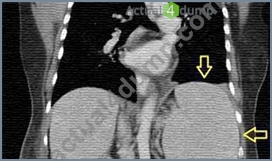
Splenomegaly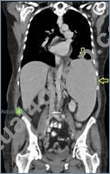
An x-ray of a person's body Description automatically generated
The patient's presentation is suggestive of splenic abscess, which is a rare but serious complication of splenomegaly. Splenic abscess is caused by bacterial or fungal infection of the spleen, usually from hematogenous spread or contiguous spread from adjacent organs. The most common symptoms are fever, chills, abdominal pain, and left shoulder pain (Kehr sign). The most significant laboratory finding is positive blood cultures, which indicate systemic infection and sepsis. Other laboratory findings may include leukocytosis, anemia, thrombocytopenia, elevated inflammatory markers, and abnormal liver function tests.
However, these are nonspecific and may vary depending on the underlying cause of splenomegaly and the type of microorganism involved.
References:
* Splenic Abscess - Infectious Disease Advisor
* Cross-sectional imaging findings of splenic infections: is ... - Springer
NEW QUESTION # 255
Acute liver failure, also known as Fulminant Hepatic Failure (FHF), is defined by a coagulation abnormality and:
- A. hepatorenal syndrome
- B. spontaneous bacterial peritonitis
- C. a cirrhotic liver
- D. encephalopathy without previous liver disease
Answer: D
Explanation:
Fulminant Hepatic Failure (FHF) is characterized by the development of impaired hepatic synthetic function with coagulopathy and the development of hepatic encephalopathy in the absence of underlying liver disease within a period of two to three months. The coagulation abnormality is usually manifested by an INR > 1.5.
Cirrhosis of the liver is a common cause of liver failure, while hepatorenal syndrome and spontaneous bacterial peritonitis are possible manifestations of liver failure.
NEW QUESTION # 256
What is the MOST important indicator of cerebral functioning in the critically ill patient?
- A. Eye response
- B. Level of consciousness (LOC)
- C. Motor response
- D. Respiratory response
Answer: B
Explanation:
The single most important indicator of cerebral functioning is the LOC. The LOC is assessed in the critically ill patient using the Glasgow Coma Scale (GCS).
Components of the GCS include a baseline pupil assessment and eye response, motor functioning assessment, and respiratory assessment.
NEW QUESTION # 257
What is the nonsurgical intervention for the treatment of Peripheral Artery Disease (PAD)?
- A. Cardiac catheterization
- B. Angioplasty
- C. Angiography
- D. Endarterectomy
Answer: B
Explanation:
Angioplasty is a minimally invasive, endovascular procedure to widen narrowed or obstructed arteries or veins, typically to treat arterial atherosclerosis. Angioplasty, with and without stent placement, is recommended in patients with severe PAD that is amendable by the nonsurgical route. A deflated balloon attached to a catheter is passed over a guide-wire into the narrowed vessel and then inflated to a fixed size. The balloon forces expansion of the blood vessel and the surrounding muscular wall, allowing improved blood flow. A stent may be inserted at the time of ballooning to ensure the vessel remains open, and the balloon is then deflated and withdrawn. Stents may keep the arteries open with a lower restenosis rate over angioplasty alone.
Angiography is a diagnostic test, not an intervention, in the treatment of PAD. Endarterectomy is a surgical intervention to remove or bypass the fatty deposits, or blockage, in an artery narrowed by the buildup of fatty tissue (atherosclerosis). Cardiac catheterization is used for evaluation of valvular heart disease, not PAD.
NEW QUESTION # 258
When considering patient advocacy, the nurse understands which of the following is TRUE?
- A. It is only a necessity when the patient is unable to make their own healthcare decisions
- B. The principle of advocacy is very similar to the principle of autonomy
- C. It is an essential role of the nurse
- D. It is a secondary ethical principle, that may be overridden by other more important ethical principles
Answer: C
Explanation:
Advocacy is one of the core ethical principles of nursing and is essential to the role of a nurse. It refers to the use of one's own skills and knowledge to promote the interests of another. Advocacy will not be a secondary ethical principle in most situations, and should be practiced even when ethical conflicts occur.
Advocacy is always necessary for the patient, even when the patient is able to make their own decisions.
The principle of advocacy is separate from the principle of autonomy. Autonomy involves the patient's right to make their own decisions, while advocacy involves representing the patient's best interests.
These two principles may conflict at times.
NEW QUESTION # 259
A nurse is caring for a patient who had a gastric bypass procedure 2 days ago. A physician has ordered a gastric tube to be placed due to increased abdominal distention. The nurse realizes that this procedure will most likely need to be done
- A. using ultrasound.
- B. under fluoroscopy.
- C. by two nurses.
- D. with a guide wire.
Answer: B
Explanation:
After gastric bypass surgery, the altered anatomy of the gastrointestinal tract makes it challenging to place a gastric tube. Performing the procedure under fluoroscopy provides real-time imaging guidance, ensuring correct placement and reducing the risk of complications, such as perforation or misplacement.References: = CCRN Exam Handbook, page 45
NEW QUESTION # 260
A patient is experiencing lower left quadrant pain with guarding, as well as abdominal distention and rigidity.
KUB reveals free air in the abdominal
cavity. Vital signs are:
BP76/40
HR130
RR32
T101.7° F (38.7°C)
A nurse would suspect
- A. paralytic ileus.
- B. appendicitis.
- C. perforated bowel.
- D. acute pancreatitis.
Answer: C
Explanation:
The clinical presentation of lower left quadrant pain with guarding, abdominal distention, rigidity, and free air in the abdominal cavity on a KUB (kidney, ureter, and bladder) radiograph strongly suggests a perforated bowel. The presence of free air indicates that there is a breach in the gastrointestinal tract, allowing air to escape into the peritoneal cavity. The patient's vital signs, including hypotension (BP 76/40), tachycardia (HR
130), tachypnea (RR 32), and fever (T 101.7°F), are consistent with sepsis and shock, which are common complications of bowel perforation. References: CCRN Exam Handbook, AACN, page 30, section on Gastrointestinal.
NEW QUESTION # 261
Of the following medications given in the critical care setting, which has the LEAST potential for the development of tolerance or dependence?
- A. Fentanyl
- B. Haloperidol (Haldol)
- C. Meperidine (Demerol)
- D. Midazolam (Versed)
Answer: B
Explanation:
Haloperidol is a major tranquilizer that has been commonly used for the management of agitated or delirious patients who are unresponsive to nonpharmacologic interventions or other sedatives.
Haloperidol has the advantage of limited respiratory depression and little potential for the development of tolerance or dependence.
Midazolam is a benzodiazepine and meperidine and fentanyl are both opioids. These drugs all have potential for tolerance and/or dependence
NEW QUESTION # 262
Analyze and interpret the following ABG results:
* pH: 7.28
* PaCO2: 47 mmHg
* HCO3: 21 mEq/L
- A. Acute (uncompensated) combined acidosis
- B. Partially compensated respiratory acidosis
- C. Acute (uncompensated) metabolic acidosis
- D. Normal ABG
Answer: A
Explanation:
Normal pH ranges from 7.35-7.45. Since this patient's pH is below 7.45, the patient is experiencing acidosis. Normal CO2 (carbon dioxide) levels range from 35-45 mmHg, and normal HCO3 (bicarbonate) levels range from 22-26 mEq/L. CO2 is the respiratory component and HCO3 is the metabolic component. The component that matches the pH is the system controlling the ABG (Arterial Blood Gas).
In this scenario, all levels are acidotic, so both the metabolic and respiratory systems are contributing to the acidosis. There is no compensation present here.
NEW QUESTION # 263
Diagnosis of acute myocardial infarction (AMI) is based on two of three findings.
Of the following, which is NOT one of these findings diagnostic for acute myocardial infarction (AMI)?
- A. ST-segment elevation on ECGs
- B. Changes on serial ECGs
- C. Elevation and fall of serum cardiac enzymes
- D. History of ischemic-like symptoms
Answer: A
Explanation:
Diagnosis of AMI is based on two of three findings:
1. History of ischemic-like symptoms
2. Changes on serial ECGs (T-wave inversion or ST-segment depression)
3. Elevation and fall in level of serum cardiac biomarkers (Troponin I or T, myoglobin, and creatine kinase) Of AMI patients, 50% do not present with ST-segment elevation.
Other indicators include: ST-segment depression (may indicate NSTEMI), new left bundle branch block (LBBB) and ST-segment depression that resolves with relief of chest pain. T-wave inversion in all chest leads may indicate NSTEMI with a critical stenosis in the proximal left anterior descending coronary artery (LAD).
NEW QUESTION # 264
All of the following may cause Acute Tubular Necrosis (ATN) EXCEPT:
- A. Aminoglycosides
- B. Hypertension
- C. Sepsis
- D. Metoprolol
Answer: D
Explanation:
Acute Tubular Necrosis (ATN), the most common form of intrarenal failure, is a kidney disorder involving damage to the tubule cells of the kidneys, which can lead to acute kidney failure. Acute tubular necrosis is usually caused by a lack of oxygen to the kidney tissues (ischemia of the kidneys).
Certain medications, as well as some medical and surgical situations, are associated with the development of ATN including:
* Hypotension
* Obstetric complications
* Obstructive jaundice
* Sepsis
* Prolonged prerenal state
* Surgery
* Aminoglycosides
NEW QUESTION # 265
When providing culturally sensitive care, the critical care nurse MUST understand:
- A. Members of a specific culture, ethnicity or religion hold the same beliefs
- B. Patients should have the same standardized level of care
- C. The patient's goals are an integral part of the plan of care
- D. Evidence-based practice takes priority over the patient's expressed needs and goals
Answer: C
Explanation:
All patients should be treated as individualsfirst. Members of the same religious, social, or ethnic group may hold some common beliefs within every culture, but individual differences and personal preferences may also affect needs for care. Standards of care are developed with best practices and evidence-based guidelines in mind to support their implementation, but, again, the patient's wishes and goals should be an important driving force in care planning.
NEW QUESTION # 266
......
Updated CCRN-Adult Dumps Questions Are Available For Passing AACN Exam: https://www.actual4dump.com/AACN/CCRN-Adult-actualtests-dumps.html
Free UPDATED AACN CCRN-Adult Certification Exam Dumps is Online: https://drive.google.com/open?id=1beQCX_xu-3Hw3h1aXt9zG_hRzPCg0CbT