

[Apr-2024] PEGACPSSA23V1 Pre-Exam Practice Tests | Exam Questions and Answers for Certified Senior System Architect Study Guide
Certified Pega Senior System Architect 23 Certification Sample Questions
NEW QUESTION # 69
Your application contains the following versions of a service level named AuthorizeClaim.
The application is being updated with a new version of the AccountManage ruleset. As part of the update, the service level is no longer circumstanced for AccountOpen cases. The update must retain the circumstancing for the other case types in the application.
Which option do you use to reset the circumstancing for the AccountOpen case type?
- A. Copy the non-circumstanced rule to the AccountOpen class and select the base rule option.
- B. Make the circumstanced rules in the AccountOpen class unavailable.
- C. Withdraw the circumstanced rules in the AccountOpen class.
- D. Block the circumstanced rules in the AccountOpen class.
Answer: C
Explanation:
Withdrawing the circumstanced rules in the AccountOpen class is the correct action to stop using a circumstanced rule. This allows the non-circumstanced (or base) rule to be used instead without affecting other circumstanced versions of the rule for different case types. Reference: Pega Platform Help - Withdrawing a rule.
NEW QUESTION # 70
The primary purpose of a production ruleset is to allow rules to be
- A. tested in a production environment
- B. reused in multiple production environments
- C. migrated to a production environment
- D. updated in a production environment
Answer: D
Explanation:
The primary purpose of a production ruleset is to allow rules to be updated in a production environment. Production rulesets are designed to hold rules that business users can modify directly in a production environment without requiring a deployment from development through testing environments. This enables quick changes to be made to decision tables, correspondence, and other rule types that business users are permitted to change. Reference: Pega official documentation on ruleset types.
NEW QUESTION # 71
Which two statements are valid regarding Pega Web Mashups? (Choose two.)
- A. A mashup can allow access to Dev Studio for full system configuration.
- B. Pega Platform limits a mashup to working on existing cases.
- C. A mashup display starts by calling either a flow or a harness from a Pega application.
- D. A user can view their worklist in an external portal and select items to take action on.
Answer: C,D
Explanation:
Reference:
Pega Web Mashups enable the embedding of Pega applications within external web pages. A mashup is initialized by calling a flow or a harness from a Pega application, allowing users to interact with Pega case management from other applications or portals. Users can also view their worklist in the external portal and select items to take action on, extending the capabilities of Pega applications to external platforms. Reference: Pega Platform Help - Pega Web Mashup.
NEW QUESTION # 72
In which scenario would a Declare OnChange rule be appropriate?
- A. When a manager approves a case, the case is routed back to the appropriate case worker.
- B. When a developer changes a view, the change is checked into a development branch.
- C. When a user updates their address, the active case is suspended until the address can be confirmed.
- D. During a nightly backup process, only updated fields are backed up.
Answer: A
Explanation:
A Declare OnChange rule is appropriate in a scenario where an immediate automatic response is required to a property change. For instance, when a manager approves a case (D), the case is routed back to the appropriate case worker. The OnChange rule can detect the approval and automatically perform the routing. Reference: Pega official documentation on Declare OnChange rules.
NEW QUESTION # 73
Which statement about managing encrypted data in Pega Platform is true?
- A. Each organization uses a custom key to encrypt its data.
- B. Filter conditions cannot reference encrypted properties in reports.
- C. Encryption policies apply to Work- and Data- classes only.
- D. Property-level encryption is a time-efficient method to encrypt data.
Answer: B
Explanation:
When properties are encrypted in Pega Platform, they cannot be used in filter conditions for reports because the data is in a non-readable format. To apply filters, the data must be decrypted, which is not typically done within the reporting tool. Reference: Pega Platform Help - Data Encryption.
NEW QUESTION # 74
Consider the following requirement: An auditing policy explicitly requires that employees cannot see the contents of complaints made against themselves.
Which security solution do you use to satisfy the requirement?
- A. Access Deny
- B. Access of Role to Object
- C. Access When
- D. Access Control Policy
Answer: D
Explanation:
To satisfy the requirement that employees cannot see complaints made against themselves, an Access Control Policy (B) is the most suitable security solution. Access Control Policies in Pega allow for the definition of conditions under which access to certain data or cases is granted or denied. By configuring a policy that checks the relationship between the complaint and the employee (such as matching IDs), the system can dynamically restrict access to sensitive information, ensuring compliance with auditing policies.Reference: Pega Community documentation on Access Control Policies.
NEW QUESTION # 75
Which statement is true about services?
- A. Services return all data in XML format.
- B. Services may process outbound requests.
- C. Services may use a listener that runs in the background.
- D. Services require a REST connector to function.
Answer: C
Explanation:
Services in Pega Platform can be configured to listen for incoming requests using background listeners. These listeners are continuously running processes that wait for requests on specific ports or addresses. When a request is received, the service processes it accordingly. This capability is crucial for enabling asynchronous communication and integration with external systems, where Pega services can act upon requests without requiring manual initiation of these interactions.Reference: Pega Community documentation on service types and listeners.
NEW QUESTION # 76
The ruleset list for an application consists of the following rulesets, ordered from highest to lowest:
A rule with an Apply to: class of TGB-HR-SelfService-Work-TimeOff references a rule named ConfirmationRequest. The four instances of ConfirmationRequest in the rules cache are shown in the following table.
Which is chosen during rule resolution?
- A. TGB-HR-SelfService-Work-TimeOff .ConfirmationRequest (SelfService:01-01-01)
- B. TGB-HR-SelfService-Work .ConfirmationRequest (SelfService:01-01-01)
- C. TGB-HR-5elfService-Work-TimeOff .ConfirmationRequest (SelfService:01-01-02)
- D. TGB .ConfirmationRequest (TGB:01-01-02)
Answer: A
Explanation:
Rule resolution in Pega follows the "Rule Resolution" algorithm, which will look for the rule that best matches the class hierarchy and the ruleset list. In this scenario, the rule that matches the Apply to: class of TGB-HR-SelfService-Work-TimeOff and is in the highest listed ruleset that is available (SelfService) will be selected. Reference: Pega SSA course materials on rule resolution.
NEW QUESTION # 77
University admission application cases automatically advance in the case life cycle if the applicant's standardized test scores are above a certain threshold. The threshold is determined each year based on the provided national average score.
Which two configurations, when applied together, support this requirement? (Choose Two)
- A. Configure a TestThreshold Configuration setting with the national average for the test score threshold.
- B. Configure a process with a decision shape that continues if the TestThreshold Configuration setting is less than the applicant's test score.
- C. Configure a process with a decision shape that continues if the TestThreshold Configuration setting is greater than the applicant's test score.
- D. Configure a TestThreshold Configuration setting that calculates the national average for the test score threshold.
Answer: A,B
Explanation:
A: Configuring a process with a decision shape that continues if the TestThreshold Configuration setting is less than the applicant's test score supports the requirement for automatic case advancement based on standardized test scores.
B: Configuring a TestThreshold Configuration setting with the national average for the test score threshold allows for the necessary comparison to determine if a case should advance automatically. Reference: Pega official documentation on decision shapes and configuration settings.
NEW QUESTION # 78
Which two statements are true about database tables in Pega Platform? (Choose Two)
- A. The PegaRULES database contains rules while PegaDATA contains work instances.
- B. The report definition rule should only be used against one table for performance reasons.
- C. The History record table contains a record of when each user logged in to the system.
- D. The Database Table rule allows configuration of a connection to a specific table.
Answer: A,D
Explanation:
A: In Pega Platform, the PegaRULES database is used to store rules, while the PegaDATA database contains work instances and other data instances.
B: The Database Table rule in Pega allows you to configure the connection settings to a specific external database table, facilitating the interaction with external data sources. Reference: Pega official documentation on Pega Platform databases and Database Table rules.
NEW QUESTION # 79
When designing reports with multiple data sources, in which two ways is an association rule different from a class join? (Choose two.)
- A. You can join multiple classes with class joins, while you cannot join multiple classes with associations.
- B. Anyone with the appropriate permissions can use associations when creating reports in the User portal.
- C. A class join is required to add a filter condition to your report.
- D. Class joins are unique to each report. Associations are reusable in any report.
Answer: B,D
Explanation:
An association rule differs from a class join in that it is a reusable rule that can be used by anyone with appropriate permissions when creating reports. This makes it available across multiple reports. Class joins, on the other hand, are specific to each report definition and are not reusable in the same way. Reference: Pega Reporting Guide - Associations vs. Joins.
NEW QUESTION # 80
Which two design configurations limit the need for horizontal scrolling when an application is used on a mobile device? (Choose two.)
- A. Use grid layouts rather than repeating dynamic layouts to display tabular data.
- B. Set the width for layouts in percentages.
- C. Set the importance for columns in repeating dynamic layouts.
- D. Limit text fields to a width of 200 pixels.
Answer: B,C
Explanation:
To prevent horizontal scrolling on mobile devices, setting the importance of columns allows for the most critical information to be shown first, potentially hiding less important columns on smaller screens. Using percentage widths for layouts ensures that the layout adapts to the screen width, which can also help prevent horizontal scrolling. Reference: Pega UI design best practices for mobile devices.
NEW QUESTION # 81
A travel reservation servicing case includes a service level for responding to requests. The service level intervals vary according to passenger status, class of service, and fare type.
Which implementation satisfies this requirement?
- A. Create a single property circumstanced rule.
- B. Create a multivariate circumstanced rule and a when rule.
- C. Create a single property circumstanced rule and a when rule.
- D. Create a multivariate circumstanced rule, a circumstance definition, and a circumstance template.
Answer: D
Explanation:
To satisfy the requirement where service level intervals vary according to multiple criteria (passenger status, class of service, and fare type), you would create a multivariate circumstanced rule, a circumstance definition, and a circumstance template. This allows you to create SLAs that vary based on the combination of these criteria. Reference: Pega official documentation on circumstancing rules.
NEW QUESTION # 82
Drag each security solution on the left to its appropriate use case.
Answer:
Explanation:
NEW QUESTION # 83
Several development teams work on different enhancements. The release date for each enhancement is uncertain. Which two options, when performed together, allow each team to keep its work separate? (Choose Two)
- A. Create a new application for each team.
- B. Create a new ruleset version for each team.
- C. Create a production ruleset for each team.
- D. Set up a branch ruleset for each team.
Answer: B,D
Explanation:
Creating a new ruleset version for each team ensures that each team's work is isolated within a specific version, preventing overlap and conflict. Setting up a branch ruleset for each team further isolates development work, allowing parallel development streams that can later be merged back into the main application ruleset. These two options, when used together, provide the most flexibility for teams working on separate enhancements with uncertain release dates. Reference: Pega Platform Help - Branch Rulesets.
NEW QUESTION # 84
Which two rule types can you mark as a relevant record? (Choose Two)
- A. Skin
- B. Property
- C. Report
- D. Section
Answer: C,D
Explanation:
The rule types that you can mark as relevant records are those that are frequently referenced and are of high importance in the application. Reports (B) and Sections (D) can be marked as relevant records to easily access and modify these important rules. Reference: Pega official documentation on relevant records.
NEW QUESTION # 85
Which two value types can be used in an Application Setting when modifying values for each production level? (Choose Two)
- A. Class
- B. Text
- C. Data transform
- D. Picklist
Answer: B,D
Explanation:
In Application Settings, you can specify different values for production levels using text (e.g., URLs, file paths) or picklists (for selecting from predefined options). These settings allow for easy adjustment of values according to the environment the application is running in. Reference: Pega Platform Help - Application Settings.
NEW QUESTION # 86
What are three valid ways to exchange data through a Pega Web Mashup? (Choose Three)
- A. Use the Javascript function doAction() to set or read data values through the hosting web page.
- B. Use a queue processor to pass updated attributes to the gadget on the hosting web page.
- C. Use an action object configured as a script to perform additional actions on a web mashup gadget.
- D. Use the data-pega-event-onpagedata attribute to configure the default value for the gadget.
- E. Use an SQL call to exchange data between the mashup and hosting web page.
Answer: A,C,D
Explanation:
In a Pega Web Mashup, valid ways to exchange data include using an action object configured as a script to perform additional actions on a web mashup gadget (A), utilizing the Javascript function doAction() to set or read data values through the hosting web page (B), and using the data-pega-event-onpagedata attribute to configure default values for the gadget (E). These methods facilitate dynamic interaction between the mashup and the hosting web page, allowing for seamless data exchange and integration of Pega functionalities into external web applications.Reference: Pega Community documentation on Pega Web Mashup and integration techniques.
NEW QUESTION # 87
You are integrating two Pega Web Mashups into a client's mortgage loan financing page. What do you configure to successfully embed both mashups?
- A. Identify unique names for each mashup.
- B. Run the mashups on the same thread.
- C. Define identical URLs for each mashup.
- D. Load both mashups simultaneously.
Answer: A
Explanation:
When integrating multiple Pega Web Mashups into a single page, it is necessary to identify unique names for each mashup to ensure that they are embedded and function independently without conflict on the client's page. Reference: Pega Platform Help - Pega Web Mashup.
NEW QUESTION # 88
In the following example, the Homelns, Homelnslnt, and Customer rulesets are configured for application validation. MyCo and MyCoInt are configured for ruleset validation. MyCo lists MyCoInt and Customer as its prerequisites, and the prerequisite for MyCoInt is Pega-ProcessCommander.
Which of the following statements is correct?
- A. Rules in MyCo can reference rules in Homelns.
- B. Rules in MyCo can reference rules in Homelnslnt.
- C. Rules in MyCoInt can reference rules in Customer.
- D. Rules in Customer can reference rules in Homelns.
Answer: A
Explanation:
In Pega's ruleset hierarchy, a ruleset can reference rules in its own ruleset as well as in any prerequisites (and their prerequisites, recursively). Since MyCo lists MyCoInt and Customer as its prerequisites and MyCoInt, in turn, lists Pega-ProcessCommander (which is not relevant here), MyCo can reference rules in both Homelns and HomelnsInt. However, since only Homelns is explicitly mentioned in the options, the correct answer is that MyCo can reference rules in Homelns. Reference: Pega SSA course materials on ruleset hierarchy and ruleset validation.
NEW QUESTION # 89
On which type of rule can you configure edit validate rules?
- A. Flow actions
- B. Activities
- C. Case types
- D. Properties
Answer: D
Explanation:
Edit validate rules are associated with properties to validate the property value when a user inputs data. Edit validate rules contain a Java function that is called to check the property value for correctness. Reference: Pega Platform Help - Edit validate rules.
NEW QUESTION # 90
You perform a major skim on the ruleset ABC:02-02 to ABC:03-01.
In the Answer area, select the ruleset versions that the skim operation uses.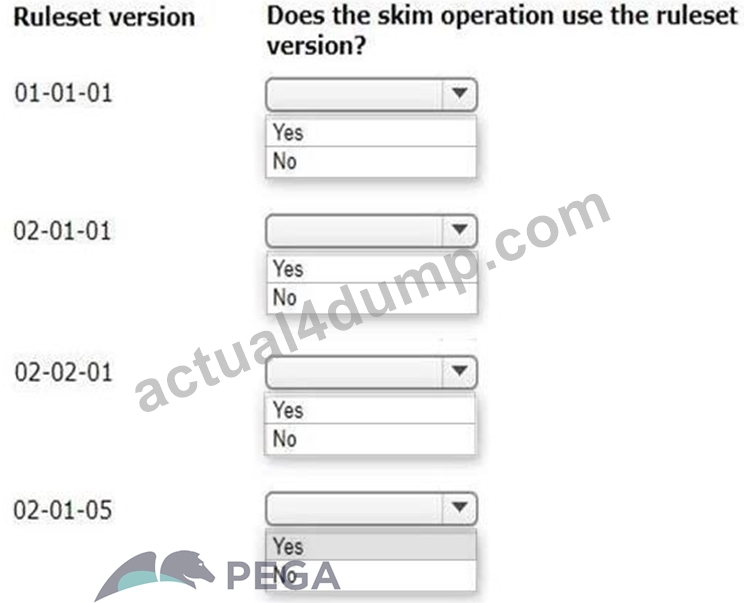
Answer:
Explanation:
NEW QUESTION # 91
How do you ensure that only a manager can run a specific flow action?
- A. Add a privilege to the flow action form, then add the privilege to a role assigned to the access group for managers.
- B. Add an Access When condition to the flow action to determine whether the user is a manager.
- C. Add a validate rule to the flow action form to determine whether the user is a manager.
- D. Add a pre-processing activity to the flow action form to determine whether the user is a manager.
Answer: A
Explanation:
To ensure that only a manager can run a specific flow action, the best approach is to add a privilege to the flow action form (B) and then assign this privilege to a role that is exclusive to managers. This role is then associated with the access group designated for managers. Privileges provide a granular level of security that can be used to control access to specific actions within a Pega application, such as executing a flow action. By leveraging privileges, you can ensure that only users with the manager role, who possess the necessary privilege, can execute the flow action, thereby enforcing the desired level of access control.Reference: Pega Community documentation on privileges, roles, and access groups.
NEW QUESTION # 92
A budgeting application uses a job scheduler to automatically email customers once a week with a breakdown of their weekly expenses. Due to the international usage of the application, stakeholders require peak performance at all hours.
Which solution addresses this performance concern?
- A. Ensure that customers use a common access group.
- B. Configure the job scheduler to run at off-hours.
- C. Limit the number of operators who can access the application.
- D. Dedicate and classify a node for the job scheduler.
Answer: D
Explanation:
Dedicating and classifying a node for the job scheduler allows the job scheduler to run on a node that is optimized for batch processing. This ensures that resource-intensive jobs do not impact the performance of the user nodes, thus maintaining peak performance at all hours. Reference: Pega Platform Help - Job Schedulers.
NEW QUESTION # 93
A hospital uses a case type to manage the treatment of patients visiting the Emergency Room (ER). Cases are created when the patient checks in at the registration desk, and are resolved when the patient is released from the hospital. Stakeholders identify the following security requirements for the case type.
* Patients access cases on a read-only basis.
* Patients can only access their own cases.
* Doctors and nurses can modify cases throughout the case life cycle.
* Only doctors are allowed to write prescriptions.
Which configuration allows doctors and nurses to modify cases while complying with all identified security requirements?
- A. Create two access roles, one for doctors and one for nurses, and set the modify action for each to 5.
- B. Create two access roles, one for doctors and one for nurses, and set the modify action for each to 1.
- C. Create a single access role for both doctors and nurses, and set the modify action to 5.
- D. Create a single access role for both doctors and nurses, and set the modify action to 1.
Answer: C
Explanation:
To allow both doctors and nurses to modify cases while complying with the identified security requirements, the best approach is to create a single access role for both doctors and nurses (C) and set the modify action to 5. This configuration grants both user groups the necessary permissions to modify cases throughout the case life cycle. By using a single access role with a high level of access for modifications, the application simplifies role management while ensuring that both doctors and nurses can perform their duties effectively, without compromising the security and integrity of patient cases.Reference: Pega Community documentation on Access Role to Object and case management best practices.
NEW QUESTION # 94
......
Pegasystems Exam Practice Test To Gain Brilliante Result: https://www.actual4dump.com/Pegasystems/PEGACPSSA23V1-actualtests-dumps.html
Tested Material Used To PEGACPSSA23V1: https://drive.google.com/open?id=1dzTrcMfmB39qT_0ZWvHR1_0QloP4gR9A