

CTFL-2018 Practice Test Questions Updated 40 Questions
ISTQB CTFL-2018 Dumps - Secret To Pass in First Attempt
What Prerequisites Are There for CTFL 2018 Exam?
No mandatory requirements are spelled out for the ISTQB CTFL 2018 test, but it’s advisable for applicants to be in deep awareness of the syllabus. Another recommendation is that any candidate aspiring to sit for the exam should have not less than six months of experience in the software testing or software development sphere. Also, passing through training from a provider that has been accredited by ISTQB will be a good choice of the preparation option. This will help you better understand the exam objectives that include:
- Testing fundamentals
- Static testing
- Testing throughout the SLDC (Software Development Lifecycle)
- Test techniques
- Test management
- Tool support aimed at testing
NEW QUESTION 14
Which defect below is MOST likely to be found by a review during static testing?
- A. Old versions of software in use.
- B. Broken links to web addresses.
- C. Incorrect interface specifications.
- D. Performance bottlenecks.
Answer: C
NEW QUESTION 15
Given the following decision tables, what is the expected result for the test case listed below?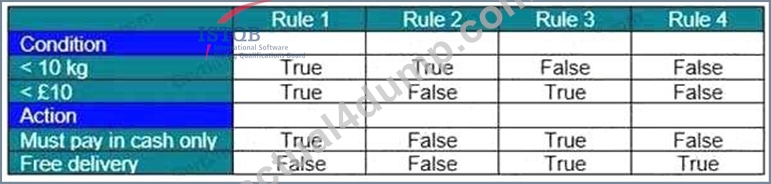
Test Case: Purchase a Toaster weighing 9kg for £10.
- A. No need to pay in cash, no free delivery.
- B. Must pay in cash, no free delivery.
- C. No need to pay in cash, free delivery.
- D. Must pay in cash, free delivery.
Answer: A
NEW QUESTION 16
A car insurance policy has 3 rates of insurance depending on the age of the driver. For drivers aged between
17 and 25 inclusive they are charged at rate A, drivers aged between 26 and 50 inclusive are charged at rate B and those drivers aged over 50 are charged at rate C.
You are designing test cases, which of the following three ages would test all valid equivalence partitions and therefore test rate A, B and C?
- A. 26, 45, 50.
- B. 20, 35, 65.
- C. 10, 21, 55.
- D. 17, 25, 50.
Answer: B
NEW QUESTION 17
An issue has been found in a production system, where a code component fails to release memory after it has finished using it. Which of the following tools would have been the MOST effective at detecting this defect during Performance testing?
- A. Dynamic analysis tool.
- B. Test Execution tool.
- C. Configuration management tool.
- D. Coverage measurement tool.
Answer: A
Explanation:
Explanation/Reference:
NEW QUESTION 18
Which of the following apply to System Testing?
a) May satisfy legal requirements.
b) Can use system specifications as a test basis.
c) Often the responsibility of business users.
d) Main goal is to establish confidence.
e) Should focus on the communication between systems.
- A. c and e.
- B. a and c.
- C. b and d.
- D. a and b.
Answer: C
NEW QUESTION 19
Given the following state transition diagram where SS is the start state: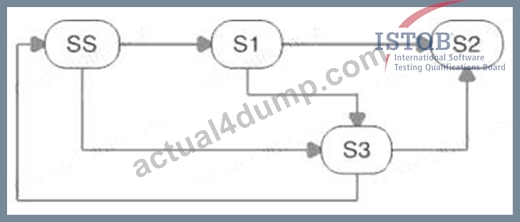
Which of the following answers describes a test case that only uses valid transitions to exercise all states, using the minimum number of transitions?
- A. SS-S3-SS-S1-S3-S2.
- B. SS-S3-S2-S1.
- C. SS-S1-S3-S2.
- D. SS-S1-S2-S3.
Answer: C
NEW QUESTION 20
Testing effort can depend on a number of factors, which one of the following is MOST likely to impact the amount of effort required?
- A. The planned use of a project management tool to schedule tasks.
- B. The ratio of developers to testers in the project team.
- C. The responsibilities for testers and developers being clearly defined.
- D. The predicted number of defects and the amount of rework required.
Answer: A
NEW QUESTION 21
Which of the following options BEST explains the pesticide paradox principle of testing?
- A. Defects are, paradoxically, often contained in a small number of modules.
- B. Testing, like spraying pesticide, is an effective bug/defect removal activity.
- C. If we do not regularly review and revise our tests, we'll stop finding defects.
- D. Repeatedly running a set of tests will ensure that a system is defect free.
Answer: A
NEW QUESTION 22
When can functional and structural testing BOTH be applied?
- A. System and Component test levels only.
- B. All 'Development' test levels, i.e. those before Acceptance testing.
- C. All test levels.
- D. Component and Component integration test levels only.
Answer: C
NEW QUESTION 23
You have been asked to improve the way test automation tools are being used in your company. Which one of the following is the BEST approach?
- A. Keeping expected results separate from the automation tool to allow the testers to check the results.
- B. Using a keyword-driven testing approach to separate the actions and data from the tool's script.
- C. Selecting and automating scripts that test new functionality to find the most defects.
- D. Ensuring that all data, inputs and actions are stored in the tool's script for ease of maintenance.
Answer: C
Explanation:
Explanation/Reference:
Explanation/Reference:
NEW QUESTION 24
Which statement about deriving test cases from a use case is TRUE?
- A. Test cases can only be derived if there is an activity diagram.
- B. Test cases are designed to exercise the defined behaviours.
- C. There should only be one test case for each use case.
- D. It is not possible to measure use case test coverage.
Answer: B
NEW QUESTION 25
Tests have been specified for the latest software release and users have prioritised these.
However, there are some dependencies between tests as shown in the table below (e.g. Test ID. '123' cannot be run until Test ID. '456' has been successfully completed).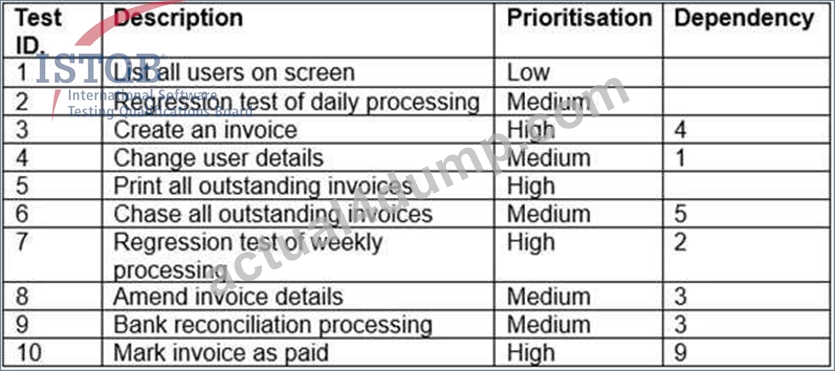
Which test execution schedule best meets the prioritisation and dependency conditions?
- A. 6, 1, 2, 9, 4, 3, 5, 7, 8, 10.
- B. 1, 4, 3, 5, 2, 7, 9, 10, 6, 8.
- C. 3, 5, 7, 10, 2, 4, 6, 8, 9, 1.
- D. 5, 7, 4, 3, 9, 10, 1, 6, 8, 2.
Answer: B
NEW QUESTION 26
A holiday club restricts those booking the holiday, to people between the ages of 18 and 30 inclusive.
Using three-point boundary values, what ages would be required to test the lower and upper boundary?
- A. 18, 19, 20, 28, 29, 30.
- B. 17, 18, 19, 30, 31, 32.
- C. 17, 18, 19, 29, 30, 31.
- D. 16, 17, 18, 30, 31, 32.
Answer: C
NEW QUESTION 27
Which of the following would achieve the HIGHEST level of testing independence for a project's system test level?
- A. Having the company's independent test team design and execute the tests.
- B. Training developers to design good tests for the test team to execute.
- C. Outsourcing test design and execution to a different company.
- D. Minimising contact between testers and developers during test design to avoid bias.
Answer: B
NEW QUESTION 28
During the development of a software change for a system, the developer makes a mistake in his work, which leads to a fault in the code. Unfortunately, the fault is not found by software testing and is released into live.
What is the DEFINITE consequence of this mistake?
- A. Contractual requirements have not been met by testing.
- B. If the defect is executed, the system may fail.
- C. The system will fail, causing a defect.
- D. Loss of money, time, or business reputation.
Answer: B
NEW QUESTION 29
Which of the following is a key difference between black box and white box test design techniques?
- A. White box techniques derive test cases from models of the software, black box techniques do not.
- B. Black box techniques use software code to derive test cases, white box techniques do not.
- C. White box techniques use functional design specifications to derive test cases, black box techniques do not.
- D. White box techniques can measure the extent of code coverage, black box techniques can not.
Answer: D
NEW QUESTION 30
Which of the following is an approach that can be used for exploratory testing?
- A. Time-boxed test sessions are created, during which a tester uses a test charter containing test objectives to guide the testing.
- B. A tester analyses, designs and implements tests based on external rules and standards.
- C. A tester methodically executes tests from a list of possible failures, based on experience, defect and failure data.
- D. Tests are designed based on the guidance of stakeholders and experts outside the test team.
Answer: D
Explanation:
Explanation
NEW QUESTION 31
......
ISTQB CTFL-2018 Exam Dumps [2021] Practice Valid Exam Dumps Question: https://www.actual4dump.com/ISTQB/CTFL-2018-actualtests-dumps.html
CTFL-2018 Dumps - Grab Out For [NEW-2021] ISTQB Exam: https://drive.google.com/open?id=13gfy1ZhClz9DDsQ-zgN7z-QiWdfogCnM