
Palo Alto Networks PCCET Exam Info and Free Practice Test | Actual4dump
Pass Palo Alto Networks PCCET Premium Files Test Engine pdf - Free Dumps Collection
NEW QUESTION 25
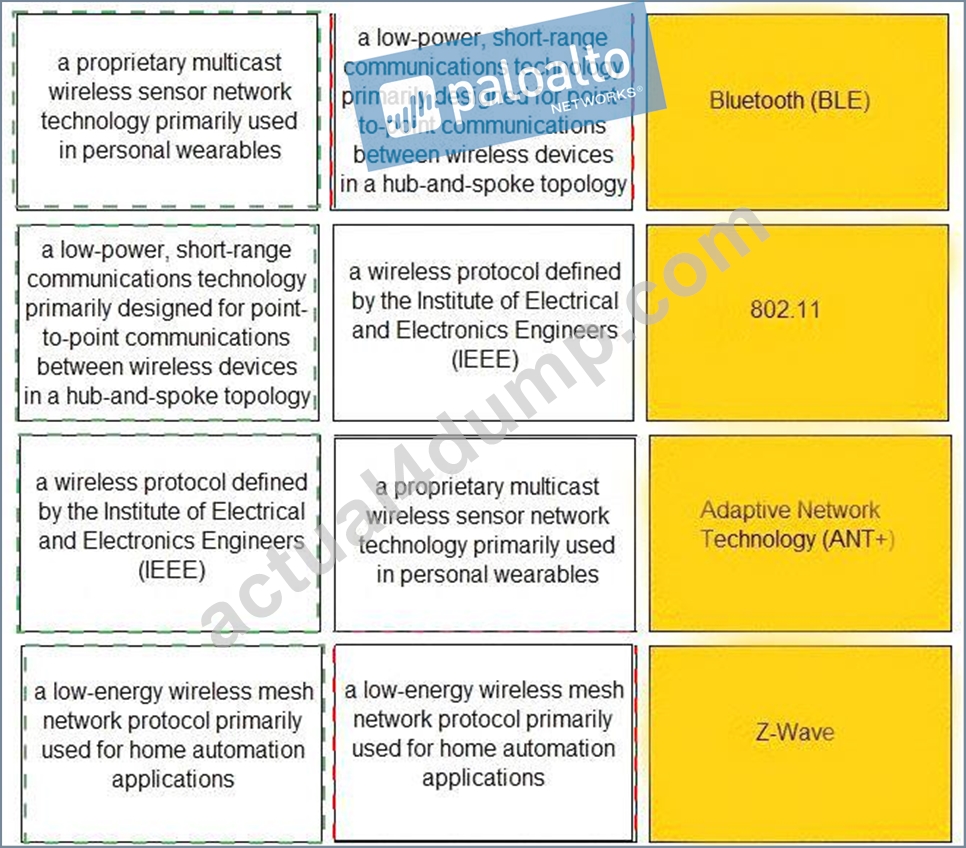
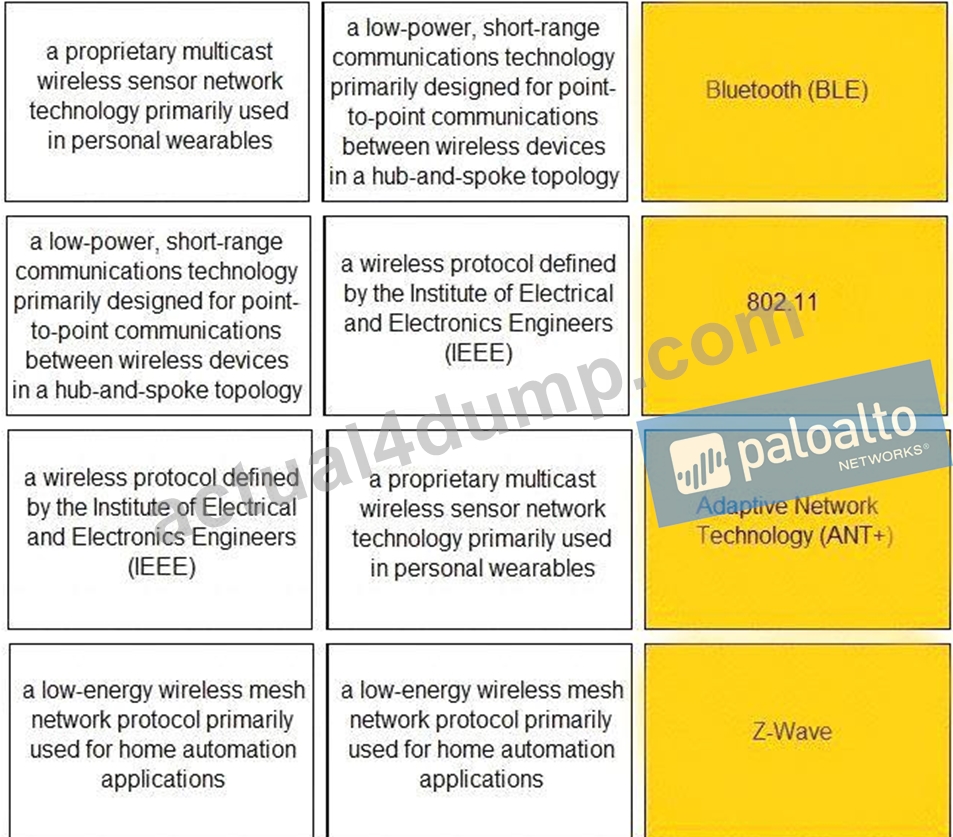
Match the IoT connectivity description with the technology.
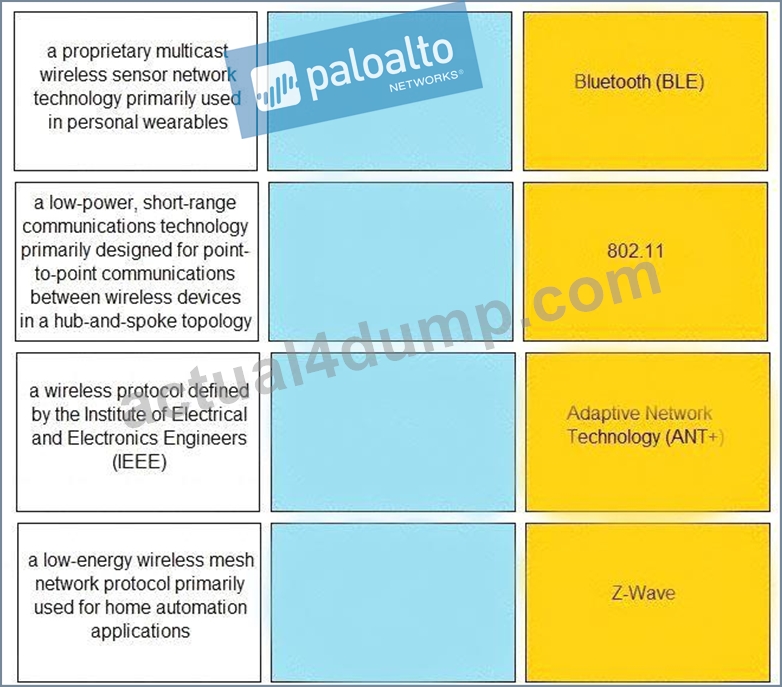
Answer:
Explanation:
NEW QUESTION 26
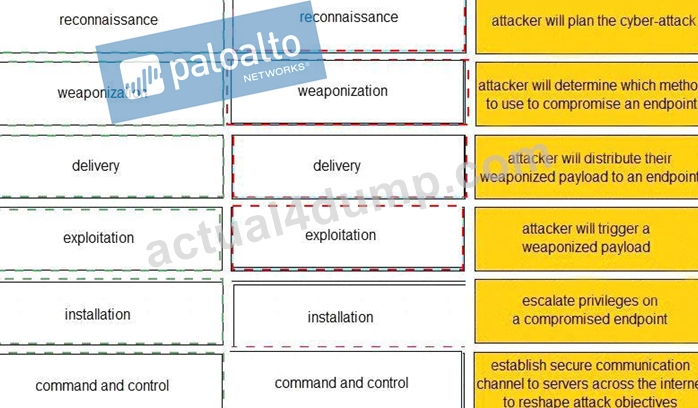
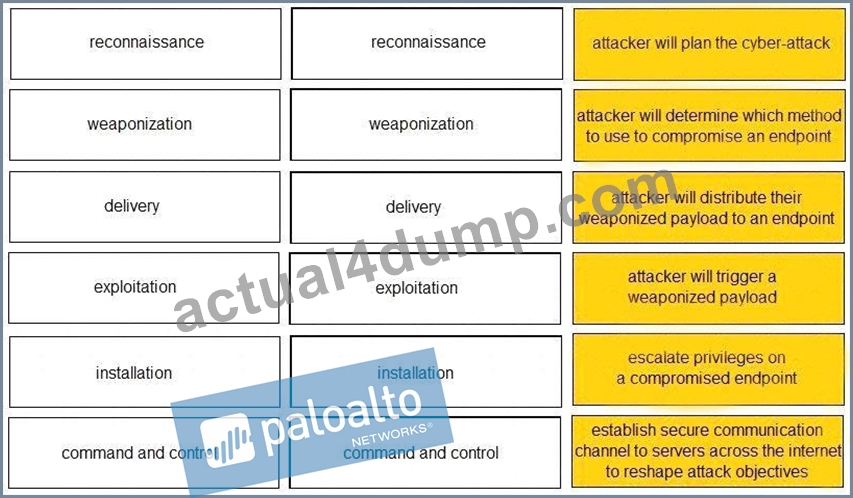
Given the graphic, match each stage of the cyber-attack lifecycle to its description.

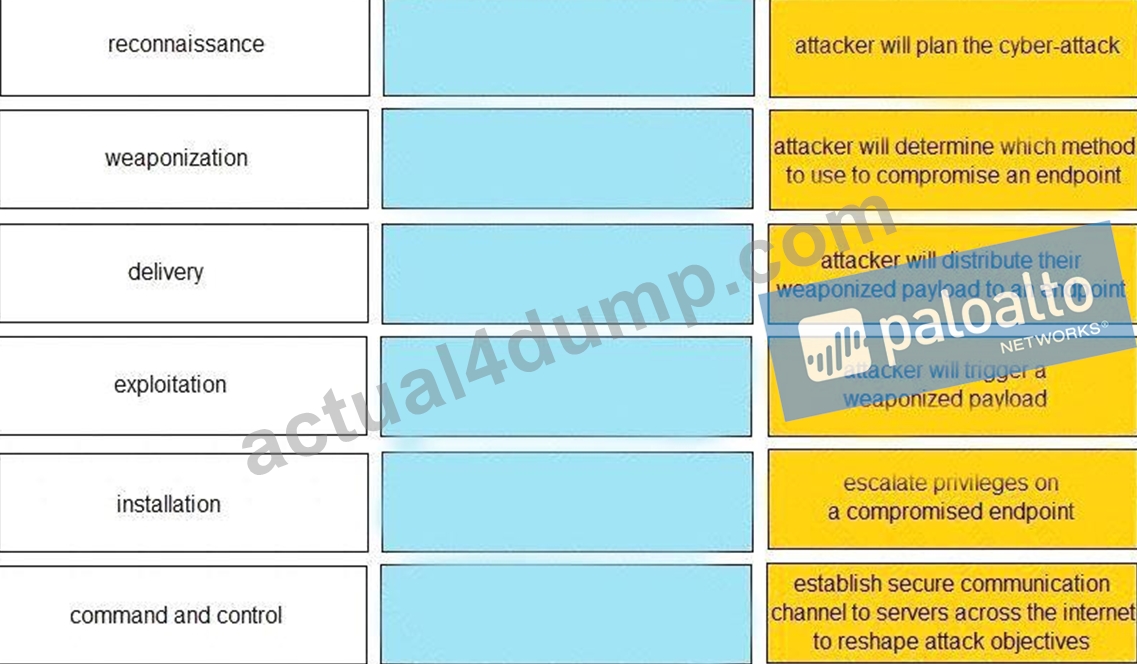
Answer:
Explanation:
NEW QUESTION 27
Which type of Software as a Service (SaaS) application provides business benefits, is fast to deploy, requires minimal cost and is infinitely scalable?
- A. Secure
- B. Sanctioned
- C. Benign
- D. Tolerated
Answer: B
Explanation:
Explanation/Reference:
NEW QUESTION 28
SecOps consists of interfaces, visibility, technology, and which other three elements? (Choose three.)
- A. People
- B. Processes
- C. Accessibility
- D. Understanding
- E. Business
Answer: A,B,E
NEW QUESTION 29
Which TCP/IP sub-protocol operates at the Layer7 of the OSI model?
- A. MAC
- B. SNMP
- C. UDP
- D. NFS
Answer: B
NEW QUESTION 30
Which analysis detonates previously unknown submissions in a custom-built, evasion-resistant virtual environment to determine real-world effects and behavior?
- A. Static
- B. Pre-exploit protection
- C. Dynamic
- D. Bare-metal
Answer: C
NEW QUESTION 31
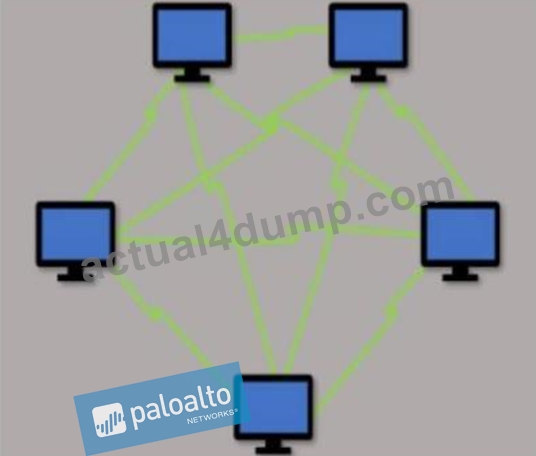
Which type of LAN technology is being displayed in the diagram?
- A. Star Topology
- B. Spine Leaf Topology
- C. Mesh Topology
- D. Bus Topology
Answer: C
NEW QUESTION 32
What does Palo Alto Networks Cortex XDR do first when an endpoint is asked to run an executable?
- A. run a static analysis
- B. run a dynamic analysis
- C. check its execution policy
- D. send the executable to WildFire
Answer: C
NEW QUESTION 33
Anthem server breaches disclosed Personally Identifiable Information (PII) from a number of its servers. The infiltration by hackers was attributed to which type of vulnerability?
- A. a phishing scheme that captured a database administrator's password
- B. an intranet-accessed contractor's system that was compromised
- C. access by using a third-party vendor's password
- D. exploitation of an unpatched security vulnerability
Answer: A
NEW QUESTION 34
Which activities do local organization security policies cover for a SaaS application?
- A. how the application processes the data
- B. how the data is backed up in one or more locations
- C. how the application can be used
- D. how the application can transit the Internet
Answer: C
NEW QUESTION 35
Which term describes data packets that move in and out of the virtualized environment from the host network or a corresponding traditional data center?
- A. North-South traffic
- B. Intrazone traffic
- C. Interzone traffic
- D. East-West traffic
Answer: A
NEW QUESTION 36
When signature-based antivirus software detects malware, what three things does it do to provide protection?
(Choose three.)
- A. remove the infected file's extension
- B. decrypt the infected file using base64
- C. alert system administrators
- D. quarantine the infected file
- E. delete the infected file
Answer: A,D,E
NEW QUESTION 37
In SecOps, what are two of the components included in the identify stage? (Choose two.)
- A. Initial Research
- B. Change Control
- C. Breach Response
- D. Content Engineering
Answer: A,D
NEW QUESTION 38
In addition to local analysis, what can send unknown files to WildFire for discovery and deeper analysis to rapidly detect potentially unknown malware?
- A. AutoFocus
- B. MineMild
- C. Cortex XDR
- D. Cortex XSOAR
Answer: C
NEW QUESTION 39
Which Palo Alto Networks product provides playbooks with 300+ multivendor integrations that help solve any security use case?
- A. AutoFocus
- B. Cortex XDR
- C. Prisma Cloud
- D. Cortex XSOAR
Answer: D
NEW QUESTION 40
The customer is responsible only for which type of security when using a SaaS application?
- A. data
- B. physical
- C. platform
- D. infrastructure
Answer: A
NEW QUESTION 41
Which organizational function is responsible for security automation and eventual vetting of the solution to help ensure consistency through machine-driven responses to security issues?
- A. DevOps
- B. SecOps
- C. NetOps
- D. SecDevOps
Answer: B
NEW QUESTION 42
Data Loss Prevention (DLP) and Cloud Access Security Broker (CASB) fall under which Prisma access service layer?
- A. Cloud
- B. Management
- C. Security
- D. Network
Answer: C
NEW QUESTION 43
What are two key characteristics of a Type 1 hypervisor? (Choose two.)
- A. is hardened against cyber attacks
- B. runs without any vulnerability issues
- C. runs within an operating system
- D. allows multiple, virtual (or guest) operating systems to run concurrently on a single physical host computer
Answer: C,D
NEW QUESTION 44
How does DevSecOps improve the Continuous Integration/Continuous Deployment (CI/CD) pipeline?
- A. DevSecOps does security checking after the application code has been processed through the CI/CD pipeline
- B. DevSecOps improves pipeline security by assigning the security team as the lead team for continuous deployment
- C. DevSecOps unites the Security team with the Development and Operations teams to integrate security into the CI/CD pipeline
- D. DevSecOps ensures the pipeline has horizontal intersections for application code deployment
Answer: C
NEW QUESTION 45
Which two network resources does a directory service database contain? (Choose two.)
- A. Services
- B. /etc/shadow files
- C. Terminal shell types on endpoints
- D. Users
Answer: A,D
NEW QUESTION 46
Which type of Wi-Fi attack depends on the victim initiating the connection?
- A. Jasager
- B. Parager
- C. Mirai
- D. Evil twin
Answer: A
NEW QUESTION 47
Which option describes the "selective network security virtualization" phase of incrementally transforming data centers?
- A. during the selective network security virtualization phase, all intra-host traffic is encapsulated and encrypted using the IPSEC protocol
- B. during the selective network security virtualization phase, all intra-host communication paths are strictly controlled
- C. during the selective network security virtualization phase, all intra-host traffic is forwarded to a Web proxy server
- D. during the selective network security virtualization phase, all intra-host traffic is load balanced
Answer: B
NEW QUESTION 48
......
Palo Alto PCCET Exam Topics:
| Section | Weight | Objectives |
|---|
| Fundamentals of Cybersecurity | 15% | - Identify Web 2.0/3.0 applications and services- List common Web 2.0/3.0 applications.
- Differentiate between SaaS, PaaS and IaaS.
- Distinguish between Web 2.0 and 3.0 applications and services.
- Recognize applications used to circumvent port-based firewalls - Identify applications by their port number.
- Understand port scanning.
- Understand how to use port scanning tools.
- Understand different risk levels of applications.
- Understand the impact of using non standard ports.
- Summarize cloud computing challenges and best practices - Define DevOps.
- Understand the impact of Service Level Agreements (SLA) with cloud contracts.
- Differentiate between cloud types.
- Understand the application of the security within the different types of clouds.
- Understand the impact of change management.
- Understand the roles within a cloud environment.
- Identify SaaS application risks - Understand the nature of data being stored in the SaaS application.
- Understand roles within a SaaS environment.
- Understand who has access to what within a system.
- Understand security controls for SaaS applications.
- Recognize cybersecurity laws and regulations - Understand the impact of governance regulation and compliance.
- Differentiate between major cybersecurity laws and implications.
- Understand governance versus regulations.
- Understand the code of professional conduct.
- List recent high-profile cyberattack examples - List recent high-profile cyberattack examples.
- Understand how to use CVE.
- Understand how to use CVS.
- Given a cyberattack example, identify what key vulnerability exists.
- Identify a leading indicator of a compromise.
- Discover attacker profiles and motivations. - Identify the different attacker profiles.
- Understand the different value levels of the information that needs to be protected.
- Identify motivations of different types of actors.
- Describe the modern cyberattack life-cycle - Understand the different phases of the modern cyber life-cycle.
- Understand events at each level of the cyber life-cycle.
- Classify malware types - Classify the different types of malware.
- Understand appropriate actions for the different types of malware.
- Identify the characteristics and capabilities for different types of malware.
- List the differences between vulnerabilities and exploits - Order the steps on the vulnerability/exploit timeline.
- Differentiate between vulnerabilities and exploits.
- Categorize spamming and phishing attacks - Differentiate between spamming and phishing attacks.
- Given specific examples, define the type of attack.
- Identify what the chain of events are as a result of an attack.
- Social Engineering - Identify different methodologies for social engineering.
- Identify what the chain events are as a result of social engineering.
- Cybersecurity Attacks - Differentiate between DoS and DDoS
- Define the functionality of bots and botnets.
- Differentiate between the use of a bot or botnets.
- Understand the type of IoT devices that are part of a botnet attack.
- Understand the purpose for Command and Control (C2).
- Differentiate the TCP/IP roles in DDoS attacks.
- Define the characteristics of advanced persistent threats - Understand advanced persistent threats.
- Understand the purpose for Command and Control (C2).
- Identify where the indicators are located.
- Recognize common Wi-Fi attacks - Differentiate between different types of Wi-Fi attacks.
- Identify common attack areas for Wi-Fi attacks.
- Understand how to monitor your Wi-Fi network.
- Define perimeter-based network security - Define perimeter-based network security.
- Define DMZ.
- Define where the perimeter is located.
- Differentiate between North and South and East and West Zones.
- Identify the types of devices used in perimeter defense.
- Understand the transition from a trusted network to an untrusted network.
- Explain Zero Trust design principles and architecture configuration - Define Zero Trust.
- Differentiate between Trust and Untrust zones.
- Identify the benefits of the Zero Trust model.
- Identify the design principles for Zero Trust.
- Understand microsegmentation.
- Define the capabilities of an effective Security Operating Platform - Understand the integration of services for Network, Endpoint, and Cloud services.
- Identify the capabilities of an effective Security Operating Platform.
- Understand the components of the Security Operating Platform.
- Recognize Palo Alto Networks Strata, Prisma, and Cortex Technologies - Identify examples of Palo Alto Networks technologies associated with securing the enterprise.
- Describe Palo Alto Networks approach to securing the cloud through the most comprehensive threat protection, governance, and compliance offering in the industry.
- Understand how Palo Alto Networks technology natively integrates network, endpoint, and cloud to stop sophisticated attacks.
|
| The Connected Globe | 25% | - Define the differences between hubs, switches, and routers- Differentiate between hubs, switches and routers.
- Define the role of hubs, switches and routers.
- Given a network diagram, Identify the icons for hubs, switches and routers.
- Understand the use of VLANs.
- Classify routed and routing protocols - Identify routed protocols.
- Identify routing protocols
- Differentiate between static and dynamic routing protocols.
- Differentiate between link state and distance vector.
- Summarize area networks and topologies - Identify the borders of collision domains.
- Identify the borders of broadcast domains.
- Identify different types of networks.
- Identify WAN technologies.
- Understand the advantages of SD-WAN.
- Understand LAN technologies.
- Explain the purpose of the Domain Name System (DNS) - Understand the DNS hierarchy.
- Understand the DNS record types.
- Understand how DNS record types are used.
- Identify a fully qualified domain name (FQDN).
- Identify categories of Internet of Things (IoT) - Identify IoT connectivity technologies.
- Identify the known security risks associated with IoT.
- Identify the security solutions for IoT devices.
- Differentiate between categories of IoT devices.
- Illustrate the structure of an IPV4/IPV6 address - Identify dotted decimal notation.
- Identify the structure of IPV6.
- Understand the purpose of IPV4 and IPV6 addressing.
- Understand the purpose of a default gateway.
- Understand the role of NAT
- Understand the role of ARP.
- Describe the purpose of IPV4 subnetting. - Understand binary to decimal conversion.
- Understand CIDR notation.
- Define classful subnetting.
- Given a scenario, identify the proper subnet mask.
- Understand the purpose of subnetting.
- Illustrate the OSI and TCP/IP models - Identify the order of the layers of both OSI and TCP/IP models.
- Compare the similarities of some OSI and TCP/IP models.
- Identify the function of each of the layers.
- Understand the advantages of using a layered model.
- Identify protocols at each layer.
- Explain the data encapsulation process - Understand the data encapsulation process.
- Understand the PDU format used at different layers.
- Classify the various types of network firewalls - Identify the characteristics of various types of network firewalls
- Understand the applications of the different types of network firewalls.
- Compare intrusion detection and intrusion prevention systems - Understand the concept of intrusion detection systems.
- Understand the concept of intrusion prevention systems.
- Differentiate between intrusion detection systems and intrusion prevention systems.
- Differentiate between knowledge-based and behavior-based systems.
- Define virtual private networks - Define virtual private networks.
- Differentiate between IPSec and SSL.
- Differentiate between the different tunneling protocols.
- Understand when to use a VPN.
- Understand the benefits of tunneling protocols.
- Explain data loss prevention - Define the purpose of data loss prevention.
- Understand what would be considered sensitive data.
- Understand what would be considered inappropriate data.
- Describe unified threat management - Differentiate between UTM and other portals logged into to do work.
- Understand how UTM integrates different aspects of content.
- Understand how the different content within the OSIs are being examined with UTM.
- Identify the security functions that are integrated with UTM.
- Define endpoint security basics - Understand what is an endpoint.
- Understand the advantages of endpoint security.
- Understand what endpoints can be supported.
- Given an environment, identify what security methods could be deployed.
- Understand the concept of a personal firewall.
- Understand what traffic flows through a personal firewall.
- Define host-based intrusion prevention systems.
- Understand the disadvantages of host-based intrusion prevention systems.
- Compare signature and container-based malware protection - Define signature-based malware protection.
- Define container-based malware protection.
- Differentiate between signature-based and container-based malware protection.
- Understand application whitelisting.
- Understand the concepts of false-positive and false-negative alerts.
- Define the purpose of anti-spyware software.
- Recognize types of mobile device management - Identify the capabilities of mobile device management.
- Identify the vulnerabilities of mobile devices.
- Identify different types of mobile devices.
- Understand how to secure devices using the MDM controls.
- Explain the purpose of identity and access management - Identify the As in the AAA model.
- Understand the purpose of identity and access management.
- Understand the risk of not using identity and access management.
- Understand the concept of least privilege.
- Understand the separation of duties.
- Understand RBAC and ABAC and Discretionary Access Control and Mandatory Access Control.
- Understand the user profile.
- Understand the impact of onboarding and offboarding from systems.
- Understand directory services.
- Describe configuration management - Understand configuration management.
- Identify how configuration management interacts with different development methodologies.
- Understand system services required for configuration Management.
- Identify next-generation firewall features and capabilities - Differentiate between NGFWs and FWs.
- Understand the integration of NGFWs with the cloud, networks and endpoints.
- Define App-ID.
- Define Content-ID.
- Define User-ID.
- Compare the NGFW four core subscription services - Differentiate between the four core NGFW subscription services.
- Define WildFire.
- Define URL Filtering.
- Define Threat Prevention.
- Define DNS security.
- Define the purpose of network security management (Panorama)
- Define Panorama services and controls.
- Understand network security management.
- Identify the deployment modes of Panorama.
|
| Cloud Technologies | 30% | - Define the NIST cloud service and deployment models- Define the NIST cloud service models.
- Define the NIST cloud deployment models.
- Recognize and list cloud security challenges - Understand where vulnerabilities are in a shared community environment.
- Understand security responsibilities.
- Understand multi-tenancy.
- Differentiate between security tools in different environments.
- Define identity and access management controls for cloud resources.
- Understand different types of alerts and notifications.
- Identify the 4 Cs of cloud native security.
- Define the purpose of virtualization in cloud computing- Define the types of hypervisors.
- Describe popular cloud providers.
- Define economic benefits of cloud computing and virtualization.
- Understand the security implications of virtualization.
- Explain the purpose of containers in application deployment - Understand the purpose of containers.
- Differentiate containers versus virtual machines.
- Define Container as a Service.
- Differentiate hypervisor from a Docker.
- Discuss the purpose of serverless computing - Understand the purpose of serverless computing.
- Understand how serverless computing is used.
- Compare the differences between DevOps and DevSecOps - Define DevOps.
- Define DevSecOps.
- Illustrate the CI/CD pipeline.
- Explain governance and compliance related to deployment of SaaS applications
- Understand security compliance to protect data.
- Understand privacy regulations globally.
- Understand security compliance between local policies and SaaS applications.
- Illustrate traditional data security solution weaknesses
- Understand the cost of maintaining a physical data center.
- Differentiate between data center security weakness of traditional solution to cloud solution.
- Differentiate between data center security weakness of traditional solution to perimeter localization solution.
- Compare east-west and north-south traffic protection- Define east-west traffic patterns.
- Define north-south traffic patterns.
- Differentiate between east-west and north-south traffic patterns.
- Recognize the four phases of hybrid data center security - Define the four phases of hybrid data center security.
- Differentiate between traditional three-tier architectures and evolving virtual data centers.
- List the four pillars of cloud application security (Prisma Cloud) - Define cloud native security platform.
- Identify the four pillars of Prisma cloud application security.
- Illustrate the Prisma Access SASE architecture - Understand the concept of SASE.
- Define the SASE layer.
- Define the Network as a Service layer.
- Define how Prisma Access provides traffic protection.
- Compare sanctioned, tolerated and unsanctioned SaaS applications
- Define application use and behavior.
- List how to control sanctioned SaaS usage.
|
| Elements of Security Operations | 30% | - List the six essential elements of effective security operations- Define the “Identify” SecOps function.
- Define the “Investigate” SecOps function.
- Define the “Mitigate” SecOps function.
- Define the “Improve” SecOps function.
- Describe the purpose of security information and event management (SIEM) and SOAR- Define SIEM.
- Define SOAR.
- Define incident and response procedures in a digital workflow format.
- Define the purpose of security orchestration, automation, and response.
- Describe the analysis tools used to detect evidence of a security compromise- Define the analysis tools used to detect evidence of a security compromise.
- Understand how to collect data that will be analyzed.
- Understand why we use analysis tools within a Security operationsenvironment.
- Define the responsibilities of a security operations engineering team.
- Describe features of Cortex XDR endpoint protection technology - Understand the Cortex platform in a Security Operations environment.
- Define the purpose of Cortex XDR for various endpoints.
- Describe how Cortex XSOAR improves SOC efficiency and how Cortex Data Lake improves SOC visibility- Understand how Cortex XSOAR improves Security Operations efficiency.
- Understand how Cortex Data Lake improves Security Operations visibility.
- Explain how AutoFocus gains threat intelligence for security analysis and response.
- Understand how AutoFocus gains threat intelligence for security analysis and response.
- Describe how AutoFocus can reduce the time required to investigate threats by leveraging third party services.
|
Palo Alto PCCET Exam Certification Details:
Updated Official licence for PCCET Certified by PCCET Dumps PDF: https://www.actual4dump.com/Palo-Alto-Networks/PCCET-actualtests-dumps.html
New 2022 Realistic PCCET Dumps Test Engine Exam Questions in here: https://drive.google.com/open?id=1HIiQZdQhso0A1NYXVa94qY477kPQCWO9
