

Verified AD0-E906 dumps Q&As - 2024 Latest AD0-E906 Download
Dumps Questions [2024] Pass for AD0-E906 Exam
NEW QUESTION # 13
A company has multiple departments that use AEM assets, but would like only one of the departments to use a custom metadata schem a. They want to add a 'verifiedBy' user picker field for its image assets.
What action should be taken to implement this requirement?
- A. Create a new metadata schema and extend the Coral UI Component to create a new user picker field
- B. Customize the /default/image metadata schema and extend the Coral Ul component to create a new user picker Field
- C. Create a new metadata schema, add a Dropdown form field and manually add the users & groups to the list.
Answer: A
Explanation:
In this scenario, the company wants only one department to use a custom metadata schema with a 'verifiedBy' user picker field for image assets. The best approach is to:
Create a new metadata schema for the specific department.
Extend the Coral UI Component to create a custom user picker field, which will allow the department to select users from the list of available users in the system.
Option A suggests modifying the default image metadata schema, which could impact all departments, and Option B involves manually adding users to a dropdown, which is not as efficient as using a user picker field.
Refer to AEM documentation on creating custom metadata schemas and extending Coral UI components for more information.
NEW QUESTION # 14
On the dispatcher, the consultant is reviewing what HTTP request methods to allow to /bin/workfront-tools. The following methods are available: GET, HEAD, POST, PUT, and DELETE.
Which requests should be allowed?
- A. GET, POST, and PUT
- B. HEAD. PUT. and DELETE
- C. DELETE POST and GET
Answer: A
NEW QUESTION # 15
A company purchases Adobe Workfront with a team plan and no Third-party products. They occasionally need to upload a document related to a task for approval. Users do not need to mark up and comment on the uploaded documents, in addition, electronic validation is not currently a requirement.
which tool should be used to meet this need?
- A. Document approvals
- B. AdobeSign
- C. Workfront Proof
Answer: A
Explanation:
Given that the company only occasionally needs to upload documents for approval and does not require advanced features like markup or electronic validation, the Document approvals feature in Workfront is the best choice.
Document approvals allow users to upload documents, assign approvers, and receive approval/rejection responses without the need for advanced proofing or signing functionality.
Options A (Workfront Proof) and B (AdobeSign) provide more advanced capabilities like markup, commenting, and e-signatures, which are unnecessary for this use case.
Refer to Workfront's document management features for more information on basic approval workflows.
NEW QUESTION # 16
A user wants to create watermarked renditions of only some of the assets in AEM Assets. Which workflow strategy should be used to achieve this goal?
- A. Modify the DAM update Asset workflow model to include the Add Watermark process.
- B. implement a new workflow process to generate a watermarked rendition of an asset. Modify the DAM Update Asset workflow model to include this workflow process.
- C. Create a new workflow model that includes the Add Watermark process, and run this workflow on the desired assets.
Answer: C
NEW QUESTION # 17
A custom field must be created to represent the Creative Manager and allow the selection of an existing resource name in the Workfront application Which type of field and object type should be selected?
- A. Field type - Calculated Field
Object type -Manager - B. Field type Typeahead
Object type User - C. Field Type - Checkboxes
Object type- User
Answer: B
Explanation:
The requirement is to allow users to select a resource (Creative Manager) from a list of existing users in the Workfront application. The appropriate solution is to use a Typeahead field with the User object type.
Field type - Typeahead: This field allows users to start typing the name of an individual, and the system will auto-suggest matching users from the Workfront database. This is ideal for scenarios where you need to assign a specific role, like a Creative Manager, from a list of existing users.
Object type - User: By using the User object type, the field will link directly to Workfront's user directory, ensuring that the selection is limited to valid, active resources in the system.
This combination of field and object type is the most efficient for assigning roles based on existing users, as it prevents errors and ensures data consistency by utilizing Workfront's internal user directory.
Options B and C are not suitable because a calculated field is not required, and checkboxes do not allow selection from a list of user names.
For further reference, consult the Custom Fields and Typeahead Fields sections in Workfront's documentation, which outline how to configure these fields to enable user selection from the organization's resource pool.
NEW QUESTION # 18
A user creates a custom metadata schema that includes a multi value text field After modifying the file that the metadata has been applied to, the user discovers that the property corresponding to the multi value text field contains a new value.
what caused the value to become populated?
- A. Another field in the metadata schema maps to the same property as the multi value text field
- B. The multi value text field is configured as a required field in the metadata schema.
- C. The multi value text field was simultaneously updated by a different ACM Assets user.
Answer: A
Explanation:
If the multi-value text field is being populated unexpectedly, the most likely cause is that another field in the metadata schema is mapped to the same property. When multiple fields are mapped to the same property in AEM, any updates to either field will overwrite or modify the property, leading to the unexpected population of values.
This can happen due to schema misconfiguration, where fields unintentionally share the same JCR property path.
Option B is incorrect because the value being required would not cause it to be populated automatically. Option C suggests simultaneous updates by different users, which is unlikely to cause the issue described.
Check the metadata schema configuration to ensure fields are mapped to distinct properties.
NEW QUESTION # 19
Metadata mappings between Adobe Workfront and the AEM have been configured A user wants to send a document and its metadata from Adobe Workfront to Adobe Experience Manager Assets.
How should the user accomplish this?
- A. Select the document in Workfront. click Send to, choose the Experience Manager integration, and metadata will synch automatically
- B. Select the document in Workfront click Send to. choose the experience Manager integration, choose the metadata to synch
- C. Select the document in workfront. choose New Version, choose the experience Manager integration, choose the metadata to synch
Answer: A
Explanation:
When metadata mappings between Adobe Workfront and AEM are configured, the process of sending a document along with its metadata from Workfront to Adobe Experience Manager (AEM) Assets is streamlined. The user selects the document in Workfront, clicks "Send to," and chooses the Experience Manager integration.
The metadata fields that have been mapped are automatically synchronized along with the document. There is no need for manual selection of metadata at this stage, as the integration ensures that all configured mappings are applied.
This functionality is part of the enhanced connector, which simplifies the workflow between Workfront and AEM Assets by automating the synchronization of mapped metadata fields during the document transfer.
For more details, refer to Adobe's documentation on Workfront for Experience Manager Enhanced Connector, which outlines how automatic metadata synchronization works during document transfers.
NEW QUESTION # 20
An implementation consultant wants to configure the enhanced connector inside a customer's Adobe Experience Manager environment. The customer needs the following functionality, automatic creation of project linked folders, comments syncing, and the automatic publishing of assets. How should the consultant navigate to the enhanced connector configuration screens?
- A. Tools > Asset> Workfront Tools Configuration, select the configuration, and select Properties in the action bar.
- B. Tools > Workfront Tools> Workfront Tools Configuration, select the configuration, and select Properties in the action bar
- C. Tools > Cloud Services > Workfront Toots Configuration, select the configuration, and select Properties in the action bar.
Answer: B
Explanation:
To configure the Enhanced Connector in AEM, including features like automatic project-linked folder creation, comment syncing, and automatic publishing of assets, you should navigate to:
Tools > Workfront Tools > Workfront Tools Configuration: This is where you can access and configure the connector settings within AEM. From there, selecting the configuration and choosing Properties in the action bar allows you to adjust the required settings.
Options B and C reference incorrect paths (Cloud Services and Assets), which are not used for the Enhanced Connector configuration.
Refer to AEM's Enhanced Connector documentation for step-by-step instructions on accessing and configuring the connector.
NEW QUESTION # 21
An implementation consultant wants to configure the enhanced connector inside a customer's Adobe Experience Manager environment. The customer needs to sync comments on linked documents from Adobe Workfront to Adobe Experience Manager.
how should this request be implemented?
- A. Select the Advanced tab Inside the enhanced connector configuration properties, and click Enable Comment Sync.
- B. Select the Event Subscriptions tab inside the enhanced connector configuration properties, and click Unable Comment Sync.
- C. Select the Event Subscriptions tab inside the enhanced connector configuration properties, and click Enable Workfront Event Subscriptions
Answer: C
Explanation:
To synchronize comments on linked documents from Adobe Workfront to Adobe Experience Manager, you need to enable Workfront Event Subscriptions in the enhanced connector configuration properties. Event Subscriptions allow AEM to track changes and updates from Workfront, including comment synchronization.
Workfront Event Subscriptions ensure that comments made in Workfront on linked documents are automatically synced to AEM.
Option A incorrectly references the Advanced tab, and Option C incorrectly states "Unable" instead of "Enable" Comment Sync.
Refer to AEM Enhanced Connector documentation on Event Subscriptions for step-by-step configuration.
NEW QUESTION # 22
During the configuration of the Enhanced Connector the consultant is working to make sure that the required packages are added to the pom.xmi of all subprojects. Which section should the packages be added to?
- A. Tools
- B. Servers
- C. Embedded
Answer: C
Explanation:
When adding the required packages for the Enhanced Connector in AEM, they should be added to the Embedded section of the pom.xml for all subprojects. The Embedded section is used to define dependencies that need to be bundled with the AEM project, ensuring that the connector's functionality is included in the deployment.
Option A (Tools) is incorrect because this section is used for development tools, not dependencies. Option C (Servers) refers to server configurations, which is unrelated to package embedding.
Refer to AEM Maven project documentation for more details on embedding packages in the pom.xml file.
NEW QUESTION # 23
An implementation consultant wants to configure the enhanced connector inside a customer's Adobe Experience Manager environment. The customer needs the automatic creation of project linked folder, synchronization of changes in Workfront document custom form values to AEM asset metadata, and the automatic publication of assets to Brand Portal upon project completion.
Which process does each requested functionality rely on?
- A. Workflows
- B. Event Subscriptions
- C. Webhooks
Answer: B
Explanation:
The features requested by the customer, such as automatic folder creation, synchronization of Workfront document custom form values to AEM asset metadata, and automatic publication of assets to Brand Portal upon project completion, rely on Event Subscriptions in the enhanced connector configuration.
Event Subscriptions are triggered when certain events occur, such as project completion or updates to custom form values, ensuring that the correct actions (like folder creation or asset publication) happen automatically.
Option A (Workflows) would be used for content approval processes but not for these specific automatic actions. Option B (Webhooks) can handle external notifications but is not directly relevant for these tasks within AEM and Workfront.
For more information, refer to AEM Enhanced Connector documentation on Event Subscriptions and their use in automating processes.
NEW QUESTION # 24
A customer finds an Ul issue with component (/apps/<customer-project>/<component-name>) on AEM page It needs to be fixed urgently to avoid miscommunication. The developer has been asked to urgently make the change in AEM production.
How should the developer deploy the change to an AEM Cloud Service production environment?
- A. Fix the component on local AEM and create an AEM package for that specific component that can be deployed to Production using package Manager as a one-off urgent fix
- B. Due to the urgency of the request. Make the Ul fix directly to the component on AEM Production using CRXOE and then make same change to customer code bate
- C. Fix the Ul issue as part of the customer code base and deploy the change to immutable repository using Cloud Manage' pipeline
Answer: C
Explanation:
In AEM Cloud Service, the correct approach to making changes, even urgent ones, is to update the codebase and deploy it through the Cloud Manager pipeline. This ensures that the change is part of the version-controlled, immutable repository and follows best practices for deployment.
Immutable infrastructure: AEMaaCS does not allow direct modifications to production environments (e.g., via CRXDE Lite). All changes must be deployed through Cloud Manager, ensuring consistency and traceability.
Making changes directly on production via CRXDE or deploying one-off fixes using the Package Manager (Options B and C) violates AEMaaCS's immutable infrastructure principle and is not supported.
Refer to Adobe Cloud Manager's documentation for best practices on deploying urgent fixes in AEM as a Cloud Service.
NEW QUESTION # 25
An organization uses a dropdown custom field for the type of creative assets that their internal studio produces. The studio managers use a report grouped by type of asset to determine which assets have been produced by the studio. A decision has been made to concentrate purely on digital work.
which action will prevent the print media options from being selected, while allowing historical data to display on the report?
- A. Move the print choices to the end of the dropdown list
- B. Remove the print choices on the dropdown field
- C. Hide the print choices on the dropdown field
Answer: C
Explanation:
In this case, the organization wants to prevent users from selecting print media options for new entries while still displaying historical data in reports. The best way to achieve this is to hide the print choices in the dropdown field. This approach ensures that:
Historical data remains unaffected: Since you are only hiding the options and not removing them, existing records with those print media values will continue to display in reports and other views.
No selection of new print options: By hiding these options, users will no longer be able to select them for new records, effectively preventing any further print media classifications.
Removing the print options (Option B) would delete historical data associated with them, which is not desirable for reporting. Moving them to the end of the list (Option C) doesn't restrict users from selecting them, which does not meet the objective of focusing solely on digital work.
This practice aligns with Adobe Workfront's best practices for managing dropdown fields, where options can be hidden but not removed, thus preserving the integrity of historical data while controlling future input.
For more details, refer to the Custom Fields section in Workfront's documentation, specifically around managing dropdown options and preserving historical data visibility in reports.
NEW QUESTION # 26
As part of the configuration of the Enhanced Connector configuration, an Experience Manager user Group needs to be created for all users of workfront who use the enhanced connector.
How are the Workfront users added to this group?
- A. Using the import People option in Workfront
- B. Automatically via the Enhanced Connector
- C. From the Adobe Admin Console
Answer: B
Explanation:
When configuring the Workfront Enhanced Connector in AEM, Workfront users who will use the connector are automatically added to a corresponding AEM user group via the connector. This automatic process ensures that permissions and group assignments are correctly synced between Workfront and AEM without manual intervention.
Option A (using the Import People option in Workfront) refers to importing users into Workfront, not syncing users to AEM. Option C (from the Adobe Admin Console) is related to managing users in the Adobe platform but not specifically for the Enhanced Connector.
Refer to AEM and Workfront Enhanced Connector documentation for more information on user synchronization and group management.
NEW QUESTION # 27
A user wants to create watermarked renditions of only some of the assets in AEM Assets. Which workflow strategy should be used to achieve this goal?
- A. Modify the DAM update Asset workflow model to include the Add Watermark process.
- B. implement a new workflow process to generate a watermarked rendition of an asset. Modify the DAM Update Asset workflow model to include this workflow process.
- C. Create a new workflow model that includes the Add Watermark process, and run this workflow on the desired assets.
Answer: C
Explanation:
To create watermarked renditions for only some of the assets in AEM, the best approach is to create a new workflow model that includes the Add Watermark process. This new workflow can be selectively applied to specific assets as needed, rather than modifying the global DAM Update Asset workflow which would affect all assets.
Selective application: By creating a custom workflow model, users can choose which assets will go through the watermarking process, providing more control and preventing unnecessary watermarking of all assets.
Option B and C suggest modifying the existing DAM Update Asset workflow, which could result in watermarking all assets, not just the desired ones, and is not flexible for specific asset selection.
Refer to AEM's workflow documentation for more information on creating custom workflows and adding watermark processes.
NEW QUESTION # 28
A developer modified the default image metadata schema to include a text field with the property 'myProject:photographer'. While testing, the developer edited the metadata of an asset and entered the name 'Sabastiao Salgado' onto the custom field. However, the developer encountered an Issue and noticed that the value of the custom field does not display on a component.
What is a possible cause of this issue?
- A. The namespace 'myProject is not registered.
- B. The text field does not accept special characters
- C. the properly 'myProject:photgrapher already exists and is causing conflicts.
Answer: A
Explanation:
The issue of the custom field not displaying correctly on a component is likely because the namespace 'myProject' is not registered in AEM. AEM requires that custom namespaces be registered before they can be used for storing metadata properties. Without registering the myProject namespace, the system cannot properly recognize the custom property, leading to issues displaying the value.
Namespace registration: Custom namespaces like myProject need to be defined in AEM before they can be used to store properties.
Option A is incorrect because the text field should accept special characters, and Option B is incorrect unless there is already a conflicting property name, which is not indicated in this scenario.
Refer to AEM documentation on namespace registration for steps on how to register a custom namespace in AEM.
NEW QUESTION # 29
A custom field needs to be mapped in AEM metadata mapping the field details are below:
Label - Creative Manager
Name - managerCreative Description
The resource assigned the creative manager role
How is the field from Workfront referenced in AEM?
- A. managerCreative
- B. CUSTOM FORMS: managerCreative
- C. CUSTOM FORMS Creative Manager
Answer: B
Explanation:
In Adobe Experience Manager (AEM), when mapping metadata fields from Workfront, custom form fields are referenced using the CUSTOM FORMS prefix followed by the internal name of the field. In this case:
The Label is "Creative Manager"
The Name is "managerCreative," which is the internal field name in Workfront.
To reference this field in AEM metadata, you need to use the CUSTOM FORMS: prefix followed by the field's name, making the correct reference CUSTOM FORMS: managerCreative. This ensures that AEM can correctly pull the metadata value from Workfront when syncing or using the Workfront enhanced connector for AEM.
Options A and B are incorrect because they either lack the proper formatting or are incomplete.
For more details on this configuration, you can refer to Adobe Workfront's enhanced connector documentation for AEM, particularly around metadata mapping and field referencing practices.
NEW QUESTION # 30
A company has a workflow where multiple people ate downloading and working on the same document simultaneously, which causes duplication of efforts. The company wants to use a document feature that will stop others from downloading the document when others are working on It.
Which document feature should De used?
- A. Change the document status to Unavailable
- B. Go into the document details page and dick Check out
- C. Post an update stating mat an employee is editing the document
Answer: B
Explanation:
Workfront includes a document checkout feature that allows users to lock a document when it is being edited, preventing others from downloading or editing the file simultaneously. This feature effectively stops duplication of effort and ensures that only one person can work on a document at a time.
Document Checkout: By navigating to the document details page and clicking "Check out," the document will be locked for editing by the person who checked it out. Other users will be notified that the document is being edited, and they will not be able to download or make changes until it is checked back in.
Option B is incorrect because changing the document status to "Unavailable" does not prevent downloading or editing. Option C, while helpful for communication, does not enforce restrictions, which could still lead to duplication of effort.
For more detailed information, refer to the Document Collaboration and Management section in the Adobe Workfront documentation, which outlines how the check-in/check-out system works.
NEW QUESTION # 31
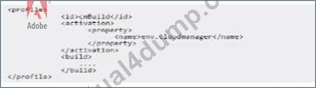
For a customer, the local deployment process needs to differ from Cloud Manager. A developer wants to execute maven profile for the Cloud Manager deployment pipeline only Which configuration should the developer use?
- A.

- B.
- C.

Answer: B
Explanation:
In the given scenario, the developer needs to execute a Maven profile specifically for the Cloud Manager deployment pipeline. This requires the use of a property that is exclusive to Cloud Manager, allowing the profile to activate only when the build is being executed in the Cloud Manager environment.
Option C uses the correct activation property:
<name>env.cloudmanager</name>
This property is specific to Adobe's Cloud Manager environment, ensuring that this Maven profile will only be activated during Cloud Manager deployments. This allows the local deployment process to remain unaffected while the correct profile is triggered in Cloud Manager.
Options A and B use other properties (env.CM_BUILD or CM_BUILD) that are not standard or specific to the Cloud Manager environment, making them incorrect choices.
For more details, you can refer to Adobe's Cloud Manager Maven Configuration documentation, which outlines how to configure Maven profiles specifically for Cloud Manager's deployment pipelines.
NEW QUESTION # 32
A consultant is working with a customer's Marketing department on an Adobe Workfront engagement. The customer has already had a successful deployment of Workfront in the IT department. This installation has been extremely simple, with a single system administrator, five custom statuses used by the IT department, and some templates and reports. The director of Marketing is adamant that the Marketing department will not be using anything created for IT. The engagement cannot disrupt the existing installation.
Which approach should the consultant take?
- A. Create groups for Marketing and it. create a group administrator for each, and share each department's resources with the group
- B. Create companies for Marketing and IT create a system administrator for each, and share each department's resources with the company
- C. Create team for Marketing and IT, create a tear administrator fix each, and share each department's resources with the team
Answer: A
Explanation:
In this scenario, the best approach is to create separate groups for Marketing and IT within the same Workfront instance. Each group will have its own group administrator, and each department's resources (e.g., custom statuses, templates, reports) can be isolated and managed independently by the group admins.
This solution ensures that:
The existing IT setup is not disrupted.
The Marketing department can have its own customized Workfront environment without overlapping with IT's configurations.
This approach avoids creating unnecessary complexity (as in Option A with companies) or restricting functionality (as in Option B with teams).
Refer to Workfront documentation on group management to learn how to implement group-specific configurations in a single instance.
NEW QUESTION # 33
An internal marketing department is building a new workflow where they need to have the task assignee upload a document. That document then needs to be reviewed and potentially marked up with annotations as part of the review process. Then the document needs to be approved by the director of creative marketing and the customer. Which document management process meets this requirement?
- A. Upload the document with a proofing approval workflow attached
- B. Upload the document using Approvals under document details
- C. Upload the document to subtask assigned to approvers
Answer: A
Explanation:
For a workflow where a task assignee must upload a document, have it reviewed and marked up with annotations, and then have it approved by the director and customer, the best option is to upload the document with a proofing approval workflow attached. Proofing workflows allow for:
Annotations: Reviewers can mark up the document with comments and annotations.
Approvals: Once the document is reviewed, it can go through the necessary approval stages, including the director and customer.
Option A (using approvals under document details) does not allow for the same level of markup and annotation as a proofing workflow. Option C (uploading to a subtask) is not an ideal way to manage the review and approval process with annotations.
Refer to Workfront's proofing documentation for more information on setting up proofing workflows with annotations and approvals.
NEW QUESTION # 34
......
Adobe AD0-E906 Exam Syllabus Topics:
| Topic | Details |
|---|---|
| Topic 1 |
|
| Topic 2 |
|
| Topic 3 |
|
| Topic 4 |
|
Updated Adobe Study Guide AD0-E906 Dumps Questions: https://www.actual4dump.com/Adobe/AD0-E906-actualtests-dumps.html
Valid AD0-E906 exam with Adobe Real Exam Questions: https://drive.google.com/open?id=1lwy3V9RB5X-JfUx6Ng0XM0aEh3obod_c